


Page 7 - MGPI_Case_Study
P. 7
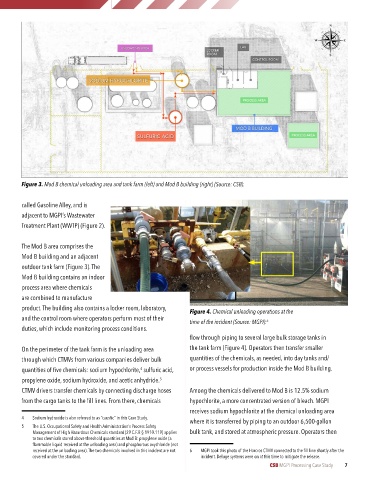
Figure 3. Mod B chemical unloading area and tank farm (left) and Mod B building (right) (Source: CSB).


        called Gasoline Alley, and is
        adjacent to MGPI’s Wastewater
        Treatment Plant (WWTP) (Figure 2).


        The Mod B area comprises the
        Mod B building and an adjacent
        outdoor tank farm (Figure 3). The

        Mod B building contains an indoor
        process area where chemicals
        are combined to manufacture
        product. The building also contains a locker room, laboratory,
                                                                Figure 4. Chemical unloading operations at the
        and the control room where operators perform most of their
                                                                time of the incident (Source: MGPI). 6
        duties, which include monitoring process conditions.
                                                                flow through piping to several large bulk storage tanks in

        On the perimeter of the tank farm is the unloading area   the tank farm (Figure 4). Operators then transfer smaller
        through which CTMVs from various companies deliver bulk   quantities of the chemicals, as needed, into day tanks and/
                                               4
        quantities of five chemicals: sodium hypochlorite,  sulfuric acid,   or process vessels for production inside the Mod B building.
                                                      5
        propylene oxide, sodium hydroxide, and acetic anhydride.
        CTMV drivers transfer chemicals by connecting discharge hoses   Among the chemicals delivered to Mod B is 12.5% sodium
        from the cargo tanks to the fill lines. From there, chemicals   hypochlorite, a more concentrated version of bleach. MGPI
                                                                receives sodium hypochlorite at the chemical unloading area
        4   Sodium hydroxide is also referred to as “caustic” in this Case Study.
                                                                where it is transferred by piping to an outdoor 6,500-gallon
        5   The U.S. Occupational Safety and Health Administration’s Process Safety
            Management of High Hazardous Chemicals standard (29 C.F.R § 1910.119) applies   bulk tank, and stored at atmospheric pressure. Operators then
            to two chemicals stored above threshold quantities at Mod B: propylene oxide (a
            flammable liquid received at the unloading area) and phosphorous oxychloride (not
            received at the unloading area). The two chemicals involved in this incident are not   6   MGPI took this photo of the Harcros CTMV connected to the fill line shortly after the
            covered under the standard.                            incident. Deluge systems were on at this time to mitigate the release.
                                                                                          CSB MGPI Processing Case Study   7

