


Page 8 - MGPI_Case_Study
P. 8
3.0    INCIDENT DESCRIPTION
        transfer sodium hypochlorite by piping into a smaller day
                                                                3.1    THE INCIDENT
        tank in the Mod B building. From there, it is transferred into a
        process vessel as needed. Another chemical delivered to Mod B   At approximately 7:35 AM on October 21, 2016, a Harcros CTMV
        is sulfuric acid. MGPI receives 30% sulfuric acid at the chemical   arrived at the MGPI Atchison facility to complete a scheduled
        unloading area in an outdoor 8,500-gallon day tank. Operators   delivery of 30% sulfuric acid. Upon arrival, the Harcros employee
                                                                      7
        transfer sulfuric acid from the day tank directly into the process.   (driver)   exited the cab and began to pressurize the cargo tank
                                                                for unloading. At approximately 7:42 AM, the driver took the
        2.3.1   PRE-INCIDENT CHEMICAL UNLOADING OPERATIONS
                                                                bills of lading to the Mod B building where the MGPI night shift

        To access the fill lines for a chemical delivery, operators first unlock   operator on duty reviewed and signed the paperwork for accepting
        a barbed wire gate that encloses the tank farm area and five fill   a delivery. Because the driver arrived at MGPI at 7:35 AM, prior to
        lines designated for each chemical (Figure 4). Next, operators   the start of dayshift, the night shift operator accepted the delivery.
        unlock the padlock on the cam lever dust cap that secures the
        fill line for the chemical being delivered. Cam lever dust caps   At 7:44 AM, the operator escorted the driver from the Mod B
        prevent access to fill lines by capping the end of the fill lines   building to the chemical unloading area. When they reached the
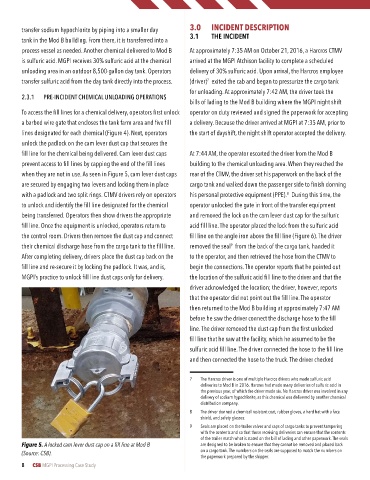
        when they are not in use. As seen in Figure 5, cam lever dust caps   rear of the CTMV, the driver set his paperwork on the back of the

        are secured by engaging two levers and locking them in place   cargo tank and walked down the passenger side to finish donning
        with a padlock and two split rings. CTMV drivers rely on operators   his personal protective equipment (PPE).   During this time, the
                                                                                                8
        to unlock and identify the fill line designated for the chemical   operator unlocked the gate in front of the transfer equipment
        being transferred. Operators then show drivers the appropriate   and removed the lock on the cam lever dust cap for the sulfuric
        fill line. Once the equipment is unlocked, operators return to   acid fill line. The operator placed the lock from the sulfuric acid
        the control room. Drivers then remove the dust cap and connect   fill line on the angle iron above the fill line (Figure 6). The driver
        their chemical discharge hose from the cargo tank to the fill line.   removed the seal   from the back of the cargo tank, handed it
                                                                             9
        After completing delivery, drivers place the dust cap back on the   to the operator, and then retrieved the hose from the CTMV to
        fill line and re-secure it by locking the padlock. It was, and is,   begin the connections. The operator reports that he pointed out

        MGPI’s practice to unlock fill line dust caps only for delivery.   the location of the sulfuric acid fill line to the driver and that the
                                                                driver acknowledged the location; the driver, however, reports
                                                                that the operator did not point out the fill line. The operator
                                                                then returned to the Mod B building at approximately 7:47 AM
                                                                before he saw the driver connect the discharge hose to the fill
                                                                line. The driver removed the dust cap from the first unlocked
                                                                fill line that he saw at the facility, which he assumed to be the

                                                                sulfuric acid fill line. The driver connected the hose to the fill line
                                                                and then connected the hose to the truck. The driver checked


                                                                7   The Harcros driver is one of multiple Harcros drivers who made sulfuric acid
                                                                   deliveries to Mod B in 2016. Harcros had made many deliveries of sulfuric acid in
                                                                   the previous year, of which the driver made six. No Harcros driver was involved in any
                                                                   delivery of sodium hypochlorite, as this chemical was delivered by another chemical
                                                                   distribution company.
                                                                8   The driver donned a chemical resistant coat, rubber gloves, a hard hat with a face
                                                                   shield, and safety glasses.
                                                                9   Seals are placed on the trailer valves and caps of cargo tanks to prevent tampering
                                                                   with the contents and so that those receiving deliveries can ensure that the contents
                                                                   of the trailer match what is stated on the bill of lading and other paperwork. The seals
        Figure 5. A locked cam lever dust cap on a fill line at Mod B   are designed to be broken to ensure that they cannot be removed and placed back
        (Source: CSB).                                             on a cargo tank. The numbers on the seals are supposed to match the numbers on
                                                                   the paperwork prepared by the shipper.
        8   CSB MGPI Processing Case Study

