


Page 11 - MGPI_Case_Study
P. 11
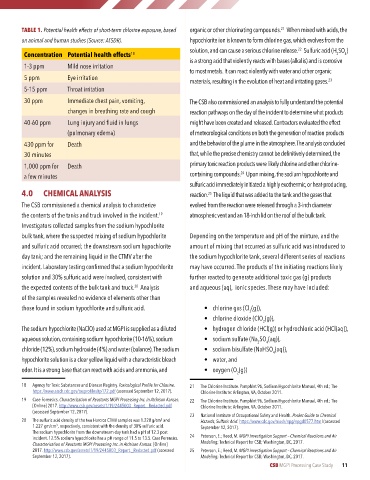
TABLE 1. Potential health effects of short-term chlorine exposure, based   organic or other chlorinating compounds.   When mixed with acids, the
                                                                                              21
        on animal and human studies (Source: ATSDR).            hypochlorite ion is known to form chlorine gas, which evolves from the
                                          18
                                                                                                    22
         Concentration Potential health effects 18              solution, and can cause a serious chlorine release.   Sulfuric acid (H SO )
                                                                                                                2
                                                                                                                   4
                                                                is a strong acid that violently reacts with bases (alkalis) and is corrosive
         1-3 ppm       Mild nose irritation
                                                                to most metals. It can react violently with water and other organic
         5 ppm         Eye irritation
                                                                                                              23
                                                                materials, resulting in the evolution of heat and irritating gases.
         5-15 ppm      Throat irritation
         30 ppm        Immediate chest pain, vomiting,          The CSB also commissioned an analysis to fully understand the potential
                       changes in breathing rate and cough      reaction pathways on the day of the incident to determine what products

         40-60 ppm     Lung injury and fluid in lungs           might have been created and released. Contractors evaluated the effect
                       (pulmonary edema)                        of meteorological conditions on both the generation of reaction products
         430 ppm for   Death                                    and the behavior of the plume in the atmosphere. The analysis concluded
         30 minutes                                             that, while the precise chemistry cannot be definitively determined, the

         1,000 ppm for   Death                                  primary toxic reaction products were likely chlorine and other chlorine-
                                                                                 24
         a few minutes                                          containing compounds.   Upon mixing, the sodium hypochlorite and
                                                                sulfuric acid immediately initiated a highly exothermic, or heat-producing,
        4.0    CHEMICAL ANALYSIS                                reaction.   The liquid that was added to the tank and the gases that
                                                                      25
        The CSB commissioned a chemical analysis to characterize   evolved from the reaction were released through a 3-inch diameter
                                                      19
        the contents of the tanks and truck involved in the incident.     atmospheric vent and an 18-inch lid on the roof of the bulk tank.
        Investigators collected samples from the sodium hypochlorite
        bulk tank, where the suspected mixing of sodium hypochlorite   Depending on the temperature and pH of the mixture, and the
        and sulfuric acid occurred; the downstream sodium hypochlorite   amount of mixing that occurred as sulfuric acid was introduced to
        day tank; and the remaining liquid in the CTMV after the   the sodium hypochlorite tank, several different series of reactions
        incident. Laboratory testing confirmed that a sodium hypochlorite   may have occurred. The products of the initiating reactions likely

        solution and 30% sulfuric acid were involved, consistent with   further reacted to generate additional toxic gas (g) products
        the expected contents of the bulk tank and truck.   Analysis   and aqueous (aq),  ionic species. These may have included:
                                              20
        of the samples revealed no evidence of elements other than
        those found in sodium hypochlorite and sulfuric acid.        • chlorine gas (Cl (g)),
                                                                                    2
                                                                     • chlorine dioxide (ClO (g)),
                                                                                        2
        The sodium hypochlorite (NaClO) used at MGPI is supplied as a diluted   •  hydrogen chloride (HCl(g)) or hydrochloric acid (HCl(aq)),
        aqueous solution, containing sodium hypochlorite (10-16%), sodium   • sodium sulfate (Na SO (aq)),
                                                                                      2  4
        chloride (12%), sodium hydroxide (4%) and water (balance). The sodium   • sodium bisulfate (NaHSO (aq)),
                                                                                           4
        hypochlorite solution is a clear yellow liquid with a characteristic bleach   • water, and
        odor. It is a strong base that can react with acids and ammonia, and   • oxygen (O (g))
                                                                               2
        18   Agency for Toxic Substances and Disease Registry. Toxicological Profile for Chlorine.   21   The Chlorine Institute. Pamphlet 96, Sodium Hypochlorite Manual, 4th ed.; The
            https://www.atsdr.cdc.gov/toxprofiles/tp172.pdf (accessed September 12, 2017).   Chlorine Institute: Arlington, VA, October 2011.
        19   Case Forensics. Characterization of Reactants MGPI Processing Inc. in Atchison Kansas.   22   The Chlorine Institute. Pamphlet 96, Sodium Hypochlorite Manual, 4th ed.; The
            [Online] 2017. http://www.csb.gov/assets/1/19/2445003_Report._Redacted.pdf   Chlorine Institute: Arlington, VA, October 2011.
            (accessed September 12, 2017).
                                                                23   National Institute of Occupational Safety and Health. Pocket Guide to Chemical
        20  The sulfuric acid density of the two Harcros CTMV samples was 1.228 g/cm  and   Hazards, Sulfuric Acid. https://www.cdc.gov/niosh/npg/npgd0577.html (accessed
                                                      3
                    3
            1.227 gm/cm , respectively, consistent with the density of 30% sulfuric acid.   September 12, 2017).
            The sodium hypochlorite from the downstream day tank had a pH of 12.3 post   Peterson, E.; Reed, M. MGPI Investigation Support – Chemical Reactions and Air
            incident. 12.5% sodium hypochlorite has a pH range of 11.5 to 13.5. Case Forensics.   24
            Characterization of Reactants MGPI Processing Inc. in Atchison Kansas. [Online]   Modeling; Technical Report for CSB; Washington, DC, 2017.
            2017. http://www.csb.gov/assets/1/19/2445003_Report._Redacted.pdf (accessed   25   Peterson, E.; Reed, M. MGPI Investigation Support – Chemical Reactions and Air
            September 12, 2017).                                   Modeling; Technical Report for CSB; Washington, DC, 2017.
                                                                                          CSB MGPI Processing Case Study   11

