


Page 9 - MGPI_Case_Study
P. 9
10
        the air pressure in the cargo tank,   checked for leaks, and upon   all three operators were forced to evacuate the building without
        not finding any, opened the facility’s valve and then the valve   respiratory protection. After exiting, operators ran northeast
        on the cargo tank to begin discharging sulfuric acid. The driver   (Figure 2) through the cloud until they reached fresh air near the
        returned to his cab, checked his air pressure on the way, climbed   railroad tracks. At the railroad tracks, one of the operators used
        inside, and set his paperwork down. During this time, the MGPI   his radio to alert MGPI employees of the emergency. Following
        day shift operator and a trainee were in the Mod B building   this alert, another company employee contacted 911 at 7:59 AM.
        discussing plant operating status with the night shift operator.
                                                                The driver, who was in the cab of the truck, first noticed the gas cloud in

                                                                his rearview mirror. He tried to get to the connection area at the rear of
                                                                the truck by running down the driver side, but the gas overwhelmed him.
                                                                The driver turned around and attempted the same from the passenger
                                                                side but again was overwhelmed by the gas. At this point, the manager
                                                                of the adjacent WWTP saw the release and shouted for the driver to
                                                                run in his direction. The WWTP manager brought the driver inside the
                                                                WWTP control room, gave him water, and radioed MGPI employees

                                                                that the driver was inside and out of the cloud. The WWTP manager
                                                                also alerted MGPI management of the release by phone and radio.


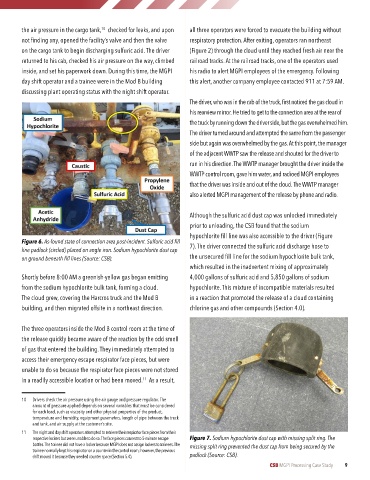
                                                                Although the sulfuric acid dust cap was unlocked immediately
                                                                prior to unloading, the CSB found that the sodium
                                                                hypochlorite fill line was also accessible to the driver (Figure
        Figure 6. As-found state of connection area post-incident. Sulfuric acid fill
        line padlock (circled) placed on angle iron. Sodium hypochlorite dust cap   7). The driver connected the sulfuric acid discharge hose to
        on ground beneath fill lines (Source: CSB).             the unsecured fill line for the sodium hypochlorite bulk tank,
                                                                which resulted in the inadvertent mixing of approximately

        Shortly before 8:00 AM a greenish-yellow gas began emitting   4,000 gallons of sulfuric acid and 5,850 gallons of sodium
        from the sodium hypochlorite bulk tank, forming a cloud.   hypochlorite. This mixture of incompatible materials resulted
        The cloud grew, covering the Harcros truck and the Mod B   in a reaction that promoted the release of a cloud containing
        building, and then migrated offsite in a northeast direction.   chlorine gas and other compounds (Section 4.0).


        The three operators inside the Mod B control room at the time of
        the release quickly became aware of the reaction by the odd smell

        of gas that entered the building. They immediately attempted to
        access their emergency escape respirator face pieces, but were
        unable to do so because the respirator face pieces were not stored
        in a readily accessible location or had been moved.   As a result,
                                                11

        10   Drivers check the air pressure using the air gauge and pressure regulator. The
            amount of pressure applied depends on several variables that must be considered
            for each load, such as viscosity and other physical properties of the product,
            temperature and humidity, equipment parameters, length of pipe between the truck
            and tank, and air supply at the customer’s site.
        11   The night and day shift operators attempted to retrieve their respirator face pieces from their
            respective lockers but were unable to do so. The face pieces connect to 5-minute escape   Figure 7. Sodium hypochlorite dust cap with missing split ring. The
            bottles. The trainee did not have a locker because MGPI does not assign lockers to trainees. The   missing split ring prevented the dust cap from being secured by the
            trainee normally kept his respirator on a counter in the control room; however, the previous
            shift moved it because they needed counter space (Section 5.4).  padlock (Source: CSB).
                                                                                          CSB MGPI Processing Case Study   9

