Page 19 - Hsslive-Plus-One-Physics-Class-Notes-Part-III (1)
P. 19
Heat,  Thermodynamics  &  Kinetic  Theory     {18}   Vinodkumar  M,  St. Aloysius  H.S.S,  Elthuruth,  Thrissur.

                          U    3                                                         3          5
                       C        R      But C  - C  = R  So  C  = C  + R.                  C   R R    R
                     V
                                                                                    P
                           T   2            P   V           P    V                       2          2
                           5
                     C       2 R    5
                     P        
                     C     3        3
                       V       R
                             2
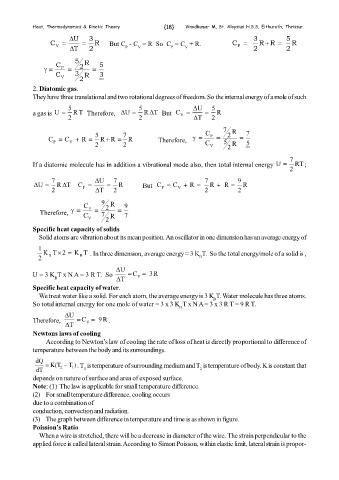
             2. Diatomic gas.
             They have three translational and two rotational degrees of freedom. So the internal energy of a mole of such
                         5                        5                   U   5
             a gas is  U   R T   Therefore,    U   R  T   But   C      R
                                                                V
                         2                        2                   T   2
                                                                               7   R
                                  5         7                            C P     2     7
                       C   C   R   R R    R               Therefore,         5  
                    P
                         V
                                  2         2                            C V     2  R  5
                                                                                                       7
             If a diatomic molecule has in addition a vibrational mode also, then total internal energy  U   RT ;
                                                                                                       2

                   7               U    7                               7           9
             U     R  T     C         R            But   C   C   R   R   R   R
                              P
                                                               V
                                                          P
                   2                T   2                               2           2
                                     9
                              C         R    9
                              P    2   
                  Therefore,
                              C      7  R    7
                                V     2
             Specific heat capacity of solids
                  Solid atoms are vibration about its mean position. An oscillator in one dimension has an average energy of
              1
                       2
                 K T     K T . In three dimension, average energy = 3 K T.  So the total energy/mole of a solid is ,
                  B
                             B
              2                                                        B
                                          U
             U = 3 K T x N A = 3 R T.  So       C  3  R
                                                 V
                    B                     T
             Specific heat capacity of water.
                  We treat water like a solid. For each atom, the average energy is 3 K T. Water molecule has three atoms.
                                                                            B
             So total internal energy for one mole of water = 3 x 3 K T x N A = 3 x 3 R T = 9 R T.
                                                                B
                        U
             Therefore,      C  9  R .
                               V
                        T
             Newtons laws of cooling
                 According to Newton’s law of cooling the rate of loss of heat is directly proportional to difference of
             temperature between the body and its surroundings.

              dQ
                   K(T   T ) . TT  is temperature of surrounding medium and T  is temperature of body. K is constant that
                      2
                          1
              dT               1                                       2
             depends on nature of surface and area of exposed surface.
             Note: (1)  The law is applicable for small temperature difference.
             (2) For small temperature difference, cooling occurs
             due to a combination of
             conduction, convection and radiation.
             (3) The graph between difference in temperature and time is as shown in figure.
             Poission’s Ratio
                  When a wire is stretched, there will be a decrease in diameter of the wire. The strain perpendicular to the
             applied force is called lateral strain. According to Simon Poisson, within elastic limit, lateral strain is propor-
   14   15   16   17   18   19   20