Page 18 - Hsslive-Plus-One-Physics-Class-Notes-Part-III (1)
P. 18
Heat,  Thermodynamics  &  Kinetic  Theory     {17}   Vinodkumar  M,  St. Aloysius  H.S.S,  Elthuruth,  Thrissur.
                                        m
                                             2
                                     2   d  
             * The smaller the no. of molecules per unit volume of the gas, larger is the mean free path.
             * Smaller the diameter, larger is the mean free path.
             * Smaller the density, larger is the mean free path.
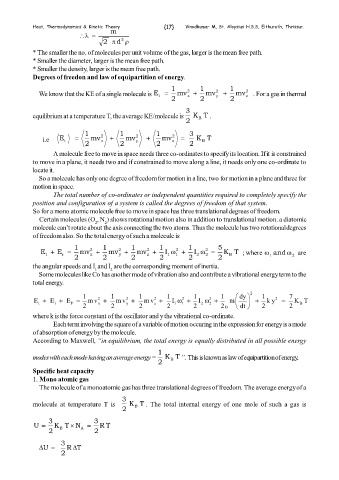
             Degrees of freedon and law of equipartition of energy.

                                                             1     2   1     2    1    2
                  We know that the KE of a single molecule is E   mv   mv  y     mv z . For a gas in thermal
                                                         t
                                                                   x
                                                             2         2          2
                                                                  3
             equilibrium at a temperature T, the average KE/molecule is   K T .
                                                                       B
                                                                  2
                               1    2      1     2      1    2     3
                   i.e      E t    mv x    mv  y       mv z       K T
                                                                        B
                               2           2            2           2
                    A molecule free to move in space needs three co-ordinates to specify its location. If it is constrained
             to move in a plane, it needs two and if constrained to move along a line, it needs only one co-ordinate to
             locate it.
                  So a molecule has only one degree of freedom for motion in a line, two for motion in a plane and three for
             motion in space.
                    The total number of co-ordinates or independent quantities required to completely specify the
             position and configuration of a system is called the degrees of freedom of that system.
             So for a mono atomic molecule free to move in space has three translational degrees of freedom.
                  Certain molecules (O , N ) shows rotational motion also in addition to translational motion. a diatomic
                                  2   2
             molecule can’t rotate about the axis connecting the two atoms. Thus the molecule has two rotational degrees
             of freedom also. So the total energy of such a molecule is

                           1     2   1     2   1     2   1     2   1     2    5
                  E   E    mv       mv       mv       I  1    I  2     K T   ; where  and    are
                                 x
                                           y
                                                     z
                       r
                                                            1
                                                                      2
                                                                                 B
                 t
                           2         2         2         2         2          2                 1       2
             the angular speeds and I and I  are the corresponding moment of inertia.
                                  1     2
                  Some molecules like Co has another mode of vibration also and contribute a vibrational energy term to the
             total energy.
                                                                                         2
                              1         1         1         1        1         1      dy   1         7
                                   2
                                             2
                                                       2
                                                                                                  2
             E    E   E      m  v     m  v     m  v    I  2    I  2     m         k  y    K   T
               t    r     P        x         y         z      1  1      2  2                              B
                              2         2         2         2        2         2 B    dt   2         2
             where k is the force constant of the oscillator and y the vibrational co-ordinate.
                    Each term involving the square of a variable of motion occuring in the expression for energy is a mode
             of absorption of energy by the molecule.
             According to Maxwell, “in equilibrium, the total energy is equally distributed in all possible energy
                                                        1
             modes with each mode having an average energy =   K T ”.  This is known as law of equipartition of energy..
                                                             B
                                                        2
             Specific heat capacity
             1. Mono atomic gas
                  The molecule of a monoatomic gas has three translational degrees of freedom. The average energy of a
                                            3
             molecule at  temperature T is    K T .  The total internal energy  of one mole  of such  a gas  is
                                                B
                                            2
                  3               3
             U     K T N   A     R T
                      B
                  2               2
                      3
                 U    R  T
                      2
   13   14   15   16   17   18   19   20