Page 16 - Hsslive-Plus-One-Physics-Class-Notes-Part-III (1)
P. 16
Heat,  Thermodynamics  &  Kinetic  Theory     {15}   Vinodkumar  M,  St. Aloysius  H.S.S,  Elthuruth,  Thrissur.
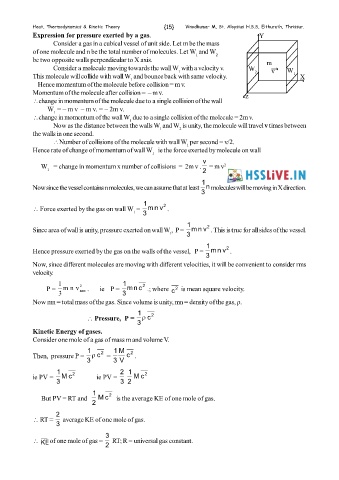
             Expression for pressure exerted by a gas.                                      Y
                    Consider a gas in a cubical vessel of unit side. Let m be the mass
             of one molecule and n be the total number of molecules. Let W  and W
                                                                      1      2
             be two opposite walls perpendicular to X axis.
                                                                                               m
                    Consider a molecule moving towards the wall W  with a velocity v.   W
                                                                1                         2     v     W
             This molecule will collide with wall W  and bounce back with same velocity.                1  X
                                               1
                 Hence momentum of the molecule before collision = m v.
             Momentum of the molecule after collision =  – m v.
                                                                                       z
             change in momentum of the molecule due to a single collision of the wall
                      W  = – m v  – m v. = – 2m v.
                    1
             change in momentum of the wall W  due to a single collision of the molecule = 2m v.
                                               1
                    Now as the distance between the walls W  and W  is unity, the molecule will travel v times between
                                                         1      2
             the walls in one second.
                    Number of collisions of the molecule with wall W  per second = v/2.
                                                                   1
             Hence rate of change of momentum of wall W  ie the force exerted by molecule on wall
                                                      1
                                                                        v
                   W = change in momentum x number of collisions  =  2m v .  = m v 2
                  1                                                     2
                                                                        1
             Now since the vessel contains n molecules, we can assume that at least  n molecules will be moving in X direction.
                                                                        3
                                                   1      2
             Force exerted by the gas on wall W  =  m  n  v .
                                                1  3

                                                                   1      2
             Since area of wall is unity, pressure exerted on wall W ,  P =  m  n  v . This is true for all sides of the vessel.
                                                             1     3
                                                                         1      2
             Hence pressure exerted by the gas on the walls of the vessel,   P =  m  n  v .
                                                                         3
             Now, since different molecules are moving with different velocities, it will be convenient to consider rms
             velocity.

                     1       2              1      2
                      P =  m  n  v rms .       ie    P =  m  n  c .; where   c 2   is mean square velocity..
                      3                     3
             Now mn = total mass of the gas. Since volume is unity, mn = density of the gas, .
                                                 1    2
                                        Pressure,  P =    c
                                                 3
             Kinetic Energy of gases.
             Consider one mole of a gas of mass m and volume V.
                                1   2    1  M  2
             Then,  pressure P =    c  =    c .
                                3        3  V

                     1    2                2  1     2
             ie PV =  M  c             ie PV =   M  c
                     3                     3  2

                                 1     2
                   But PV = RT and   M  c   is the average KE of one mole of gas.
                                 2
                     2
             RT =   average KE of one mole of gas.
                     3

                                      3
              KE  of one mole of gas =   RT; R = universal gas constant.
                                      2
   11   12   13   14   15   16   17   18   19   20