


Page 17 - Hsslive-Plus-One-Physics-Class-Notes-Part-III (1)
P. 17
Heat, Thermodynamics & Kinetic Theory {16} Vinodkumar M, St. Aloysius H.S.S, Elthuruth, Thrissur.
3 R R
KE of one molecule of gas = T ; N = Avagadro number. Here = k (Boltzmann’s constant)
2 N N
3
Average KE of one molecule of gas = k T..
2
KE T..
Average KE of gas molecules is directly proportional to absolute temperature.
Mean, rms and most probable speeds.
Mean speed( ) : It is the arithmetic mean of the speeds of gas molecules at a given temperature.
v
k T 8 R T
v ; M = mass of one mole of gas.
M M
3 k T 3 R T
rms speed (c or ) c = ( M is the mass of one mole of gas, m = mass of one
c
rms m M
molecule of gas.)
Most probable speed (v ): The most probable speed is the speed at which the maximum number of molecules
P
moves in a given gas at a given temperature.
Mean free path.
Mean free path of a molecule in a gas is the average distance treavelled by the molecule between
two successive collissions.
Molecules of a gas have finite size and behave like rigid spheres. The molecular motion is random and
hence they collide against one another frequently. Between two successive collissions, a molecule move
alo0ng a straight path with uniform velocity. This path is known as free path.
Let , , .......... are the free paths travelled by the molecules in n successive collissions, then
1 2 3 n
total distan ce travelled .............
mean free path i.e. 1 2 3 n
total no of collissions. n
Derivation of expression for mean free path.
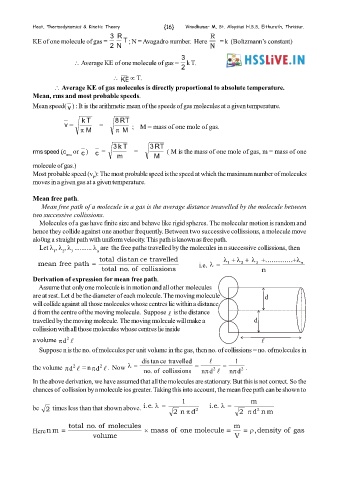
Assume that only one molecule is in motion and all other molecules
are at rest. Let d be the diameter of each molecule. The moving molecule d
will collide against all those molecules whose centres lie within a distance
d from the centre of the moving molecule. Suppose is the distance
travelled by the moving molecule. The moving molecule will make a d
collission with all those molecules whose centres lie inside
a volume d 2
Suppose n is the no. of molecules per unit volume in the gas, then no. of collissions = no. of molecules in
dis tan ce travelled 1
2 2
the volume d = n d . Now no. of collissions n d 2 n d 2 .
In the above derivation, we have assumed that all the molecules are stationary. But this is not correct. So the
chances of collission by a molecule ios greater. Taking this into account, the mean free path can be shown to
1 m
be 2 times less than that shown above. i e. . 2 i e. . 2
2 n d 2 d n m
total no of molecules. m
Here n m mass of one molecule , density of gas
volume V

