


Page 14 - Hsslive-Plus-One-Physics-Class-Notes-Part-III (1)
P. 14
Heat, Thermodynamics & Kinetic Theory {13} Vinodkumar M, St. Aloysius H.S.S, Elthuruth, Thrissur.
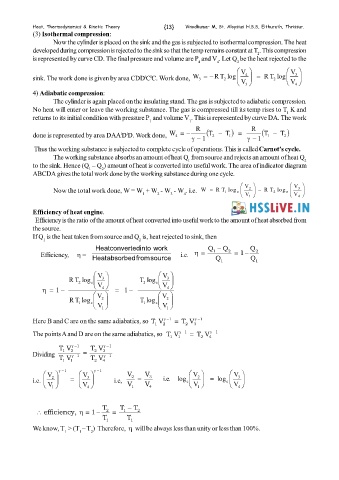
(3) Isothermal compression:
Now the cylinder is placed on the sink and the gas is subjected to isothermal compression. The heat
developed during compression is rejected to the sink so that the temp remains constant at T . This compression
2
is represented by curve CD. The final pressure and volume are P and V . Let Q be the heat rejected to the
4 4 2
V 4 V 3
l
l
sink. The work done is given by area CDDC C. Work done, W 3 TR 2 log R T 2 log
V 3 V 4
4) Adiabatic compression:
The cylinder is again placed on the insulating stand. The gas is subjected to adiabatic compression.
No heat will enter or leave the working substance. The gas is compressed till its temp rises to T K and
1
returns to its initial condition with pressure P and volume V . This is represented by curve DA. The work
1 1
R R
l
l
done is represented by area DAAD D. Work done, W T T 1 T T 2
2
1
4
1 1
Thus the working substance is subjected to complete cycle of operations. This is called Carnot’s cycle.
The working substance absorbs an amount of heat Q from source and rejects an amount of heat Q
1 2
to the sink. Hence (Q – Q ) amount of heat is converted into useful work. The area of indicator diagram
1 2
ABCDA gives the total work done by the working substance during one cycle.
V V
Now the total work done, W = W + W - W - W . i.e. W R T log e 2 R T log e 3
2
1
1 2 3 4 V V
1 4
Efficiency of heat engine.
Efficiency is the ratio of the amount of heat converted into useful work to the amount of heat absorbed from
the source.
If Q is the heat taken from source and Q is, heat rejected to sink, then
1 2
Heat converted int o work Q 1 Q 2 Q 2
Efficiency, = i.e. 1
Heat absorbed from source . Q Q
1 1
V V
R T log 3 T log 3
2 e V 2 e V
1 4 1 4
V V
R T log 2 T log 2
1 e 1 e
V 1 V 1
Here B and C are on the same adiabatics, so T V 1 T V 1
1 2 2 3
The points A and D are on the same adiabatics, so T V 1 T V 1
1 1 2 4
T V 2 1 T V 3 1
1
2
Dividing 1 1
T V T V
1 1 2 4
1 1
V V V 2 V 3 V 2 V 3
3
2
i.e. i.e, . e . i log e log e
V 1 V 4 V 1 V 4 V 1 V 4
T 2 T 1 T 2
efficiency, 1
T T
1 1
We know, T > (T – T ) Therefore, will be always less than unity or less than 100%.
1 1 2

