


Page 3 - Hsslive-Plus-One-Physics-Class-Notes-Part-III (1)
P. 3
Heat, Thermodynamics & Kinetic Theory {2} Vinodkumar M, St. Aloysius H.S.S, Elthuruth, Thrissur.
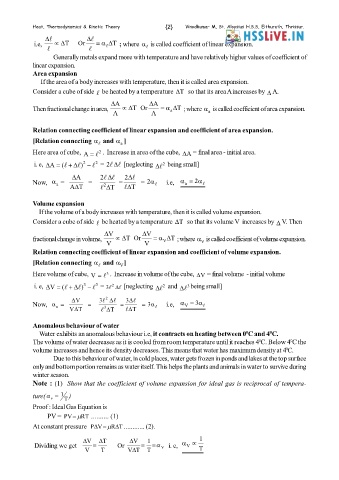
i.e, T Or T ; where is called coefficient of linear expansion.
Generally metals expand more with temperature and have relatively higher values of coefficient of
linear expansion.
Area expansion
If the area of a body increases with temperature, then it is called area expansion.
Consider a cube of side be heated by a temperature T so that its area A increases by A.
A A
Then fractional change in area, T Or T ; where is called coefficient of area expansion.
a
A A a
Relation connecting coefficient of linear expansion and coefficient of area expansion.
[Relation connecting and ]
a
Here area of cube, A 2 . Increase in area of the cube, A = final area - initial area.
2
2
i. e, A ( ) = 2 [neglecting 2 being small]
A 2 2
Now, 2 i.e, 2
a
a
A T 2 T T
Volume expansion
If the volume of a body increases with temperature, then it is called volume expansion.
Consider a cube of side be heated by a temperature T so that its volume V increases by V. . Then
V V
fractional change in volume, T Or T ; where is called coefficient of volume expansion.
V
V V V
Relation connecting coefficient of linear expansion and coefficient of volume expansion.
[Relation connecting and ]
V
Here volume of cube, V 3 . Increase in volume of the cube, V = final volume - initial volume
3
3
i. e, V ( ) = 3 2 [neglecting 2 and 3 being small]
V 3 2 3
Now, 3 3 i.e, 3
V
a
V T T T
Anomalous behaviour of water
0
0
Water exhibits an anomalous behaviour i.e, it contracts on heating between 0 C and 4 C.
0
The volume of water decreases as it is cooled from room temperature until it reaches 4 C. Below 4 C the
0
0
volume increases and hence its density decreases. This means that water has maximum density at 4 C.
Due to this behaviour of water, in cold places, water gets frozen in ponds and lakes at the top surface
only and bottom portion remains as water itself. This helps the plants and animals in water to survive during
winter season.
Note : (1) Show that the coefficient of volume expansion for ideal gas is reciprocal of tempera-
ture( 1 )
v T
Proof : Ideal Gas Equation is
PV = PV RT .......... (1)
At constant pressure P V R T ............ (2).
V T V 1 1
Dividing we get Or V i. e,
V
V T V T T T

