Page 4 - Hsslive-Plus-One-Physics-Class-Notes-Part-III (1)
P. 4
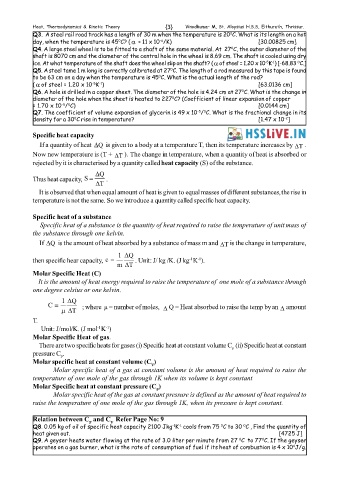
Heat,  Thermodynamics  &  Kinetic  Theory     {3}    Vinodkumar  M,  St. Aloysius  H.S.S,  Elthuruth,  Thrissur.
                                                                                  0
             Q3.  A steel rail road track has a length of 30 m when the temperature is 20 C. What is its length on a hot
                                                         -6
                                           0
             day, when the temperature is 45 C? (  = 11 x 10 /K)                           [30.00825 cm]
                                                                                  0
             Q4. A large steel wheel is to be fitted to a shaft of the same material. At  27 C, the outer diameter of the
             shaft is 8070 cm and the diameter of the central hole in the wheel is 8.69 cm. The shaft is cooled using dry
                                                                                                -1
                                                                                                         0
             ice. At what temperature of the shaft does the wheel slip on the shaft? ( of steel = 1.20 x 10 K ) [-68.83  C.]
                                                                                              -5
             Q5. A steel tame 1 m long is correctly calibrated at 27 C. The length of a rod measured by this tape is found
                                                             0
             to be 63 cm on a day when the temperature is 45 C. What is the actual length of the rod?
                                                         0
                                 -5
                                    -1
             ( of steel = 1.20 x 10 K )                                                    [63.0136 cm]
             Q6. A hole is drilled in a copper sheet. The diameter of the hole is 4.24 cm at 27 C. What is the change in
                                                                                      0
                                                             0
             diameter of the hole when the sheet is heated to 227 C? (Coefficient of linear expansion of copper
                       -5 0
             = 1.70 x 10 / C)                                                               [0.0144 cm]
                                                                      -5 0
             Q7. The coefficient of volume expansion of glycerin is 49 x 10 / C. What is the fractional change in its
             density for a 30 C rise in temperature?                                        [1.47 x 10 ]
                           0
                                                                                                     -2
             Specific heat capacity
                  If a quantity of heat  Q  is given to a body at a temperature T, then its temperature increases by   T  .
             Now new temperature is (T +   T  ). The change in temperature, when a quantity of heat is absorbed or
             rejected by it is characterised by a quantity called heat capacity (S) of the substance.
                                    Q
             Thus heat capacity, S   .
                                    T
                  It is observed that when equal amount of heat is given to equal masses of different substances, the rise in
             temperature is not the same. So we introduce a quantity called specific heat capacity.
             Specific heat of a substance
                  Specific heat of a substance is the quantity of heat required to raise the temperature of unit mass of
             the substance through one kelvin.
                  If  Q  is the amount of heat absorbed by a substance of mass m and   T  is the change in temperature,
                                          1  Q
             then specific hear capacity,  c   . Unit: J/ kg /K. (J kg K ).
                                                                      -1
                                                                   -1
                                          m T
             Molar Specific Heat (C)
                 It is the amount of heat energy required to raise the temperature of  one mole of a substance through
             one degree celsius or one kelvin.
                       1  Q
                         C      ; where   = number of moles,   Q = Heat absorbed to raise the temp by an  amount
                                                                                                   
                                                          
                         T
             T.
                   Unit: J/mol/K. (J mol K )
                                   -1
                                      -1
             Molar Specific Heat of gas.
                  There are two specific heats for gases (i) Specific heat at constant volume C  (ii) Specific heat at constant
                                                                                  V
             pressure C .
                      P
             Molar specific heat at constant volume (C )
                                                      V
                    Molar specific heat of a gas at constant volume is the amount of heat required to raise the
             temperature of one mole of the gas through 1K when its volume is kept constant
             Molar Specific heat at constant pressure (C )
                                                        P
                    Molar specific heat of the gas at constant pressure is defined as the amount of heat required to
             raise the temperature of one mole of the gas through 1K, when its pressure is kept constant.

             Relation between C  and C  Refer Page No: 9
                                P       V
                                                                                      0
                                                              -1
             Q8. 0.05 kg of oil of specific heat capacity 2100 Jkg K  cools from 75  C to 30  C , Find the quantity of
                                                                               0
                                                                -1
             heat given out.                                                                       [4725 J]
             Q9. A geyser heats water flowing at the rate of 3.0 liter per minute from 27  C  to 77 C. If the geyser
                                                                                     0
                                                                                             0
                                                                                                        4
             operates on a gas burner, what is the rate of consumption of fuel if its heat of combustion is 4 x 10 J/g.
   1   2   3   4   5   6   7   8   9