


Page 8 - Hsslive-Plus-One-Physics-Class-Notes-Part-III (1)
P. 8
Heat, Thermodynamics & Kinetic Theory {7} Vinodkumar M, St. Aloysius H.S.S, Elthuruth, Thrissur.
It is any process in which there is some change in pressure, volume or temperature of a system.
Isothermal process or Isothermal change
If a thermodynamic system, which is perfectly conducting to the surroundings, undergoes a physi-
cal process (say a change in pressure or volume) in which the temperature remains constant through-
out, the process is sai to be an isothermal process.
In such a process, if heat is developed in the system, it is given out to the surroundings or if heat is lost, it
is taken from the surroundings, so that the temperature of the system remains unchanged.
Eg: Melting and Boiling.
Consider some gas contained in a barrel of conducting material, fitted with an airtight piston. As the gas is
compressed, heat is liberated. The liberated heat goes out to keep the temp constant. When the gas is
expanded, heat is absorbed. This absorption is compensated by the transfer of heat from the surroundings,
again keeping the temp constant. Such a change is called isothermal change or process.
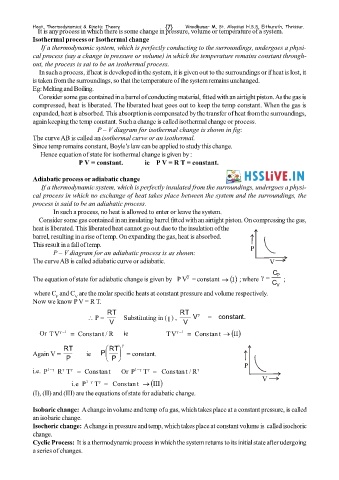
P – V diagram for isothermal change is shown in fig:
The curve AB is called an isothermal curve or an isothermal.
Since temp remains constant, Boyle’s law can be applied to study this change.
Hence equation of state for isothermal change is given by :
P V = constant. ie P V = R T = constant.
Adiabatic process or adiabatic change
If a thermodynamic system, which is perfectly insulated from the surroundings, undergoes a physi-
cal process in which no exchange of heat takes place between the system and the surroundings, the
process is said to be an adiabatic process.
In such a process, no heat is allowed to enter or leave the system.
Consider some gas contained in an insulating barrel fitted with an airtight piston. On compressing the gas,
heat is liberated. This liberated heat cannot go out due to the insulation of the
barrel, resulting in a rise of temp. On expanding the gas, heat is absorbed.
This result in a fall of temp.
P
P – V diagram for an adiabatic process is as shown:
The curve AB is called adiabatic curve or adiabatic. V
C
P
The equation of state for adiabatic change is given by P V = constant ; where ;
C V
where C and C are the molar specific heats at constant pressure and volume respectively.
P V
Now we know P V = R T.
R T R T
P = Substituting in ( ) , V cons tan . t
V V
Or TV 1 Constan t R/ ie TV 1 Constan
t
R T TR
P
Again V = ie = constant.
P P
P
t
i.e. P 1 R T Constan Or P 1 T Constan t R/
V
i e P. 1 T Constan
t
(I), (II) and (III) are the equations of state for adiabatic change.
Isobaric change: A change in volume and temp of a gas, which takes place at a constant pressure, is called
an isobaric change.
Isochoric change: A change in pressure and temp, which takes place at constant volume is called isochoric
change.
Cyclic Process: It is a thermodynamic process in which the system returns to its initial state after udergoing
a series of changes.

