


Page 5 - Hsslive-Plus-One-Physics-Class-Notes-Part-III (1)
P. 5
Heat, Thermodynamics & Kinetic Theory {4} Vinodkumar M, St. Aloysius H.S.S, Elthuruth, Thrissur.
-4
1 litre of water has mass 1 kg. [2.625 x 10 kg/s.]
Q10. A 10kW drilling machine is used to drill a bore in a small aluminium block of mass 8.0 kg. How much
is the rise in temperature in 2.5 minutes assuming 50% of the power is used up in heating the machine itself
0
0
or lost to the surroundings? (Specific heat capacity of aluminium is 0.91J/g/ ) [103 C ]
Change of state
A transition from one state (solid, liquid or gas) to another state is called change of state. There are four such
transitions of state.
Change of state Name of transition
Solid Liquid Melting
Liquid gas Vapourisation
Liquid solid Fusion
Solid gas Sublimation
(without forming liquid)
During change of state, the two different state coexist in thermal equilibrium and temperature remains
constant until the completion of change of state.
Melting point :
The temperature at which solid and liquid coexist in thermal equilibrium with each other is called melting
point. The melting point decreases with pressure
Boiling point.
The temperature at which liquid and vapor state of substance coexist in thermal equilibrium with each
other is called boiling point.
The boiling point increases with increase in pressure and it decreases with decrease in pressure.
Regelation
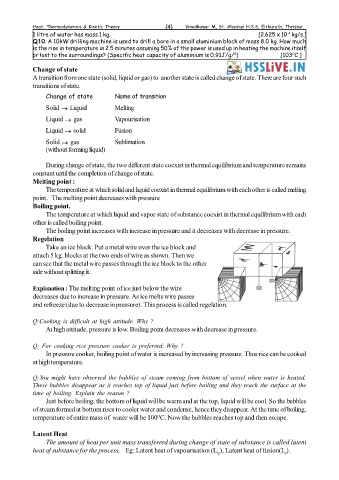
Take an ice block. Put a metal wire over the ice block and
attach 5 kg. blocks at the two ends of wire as shown. Then we
can see that the metal wire passes through the ice block to the other
side without splitting it.
Explanation : The melting point of ice just below the wire
decreases due to increase in pressure. As ice melts wire passes
and refreeze (due to decrease in pressure). This process is called regelation.
Q:Cooking is difficult at high attitude. Why ?
At high attitude, pressure is low. Boiling point decreases with decrease in pressure.
Q: For cooking rice pressure cooker is preferred. Why ?
In pressure cooker, boiling point of water is increased by increasing pressure. Thus rice can be cooked
at high temperature.
Q:You might have observed the bubbles of steam coming from bottom of vessel when water is heated.
These bubbles disappear as it reaches top of liquid just before boiling and they reach the surface at the
time of boiling. Explain the reason ?
Just before boiling, the bottom of liquid will be warm and at the top, liquid will be cool. So the bubbles
of steam formed at bottom rises to cooler water and condense, hence they disappear. At the time of boiling,
O
temperature of entire mass of water will be 100 C. Now the bubbles reaches top and then escape.
Latent Heat
The amount of heat per unit mass transferred during change of state of substance is called latent
heat of substance for the process. Eg: Latent heat of vapourisation (L ), Latent heat of fusion(L ).
V f

