


Page 6 - Hsslive-Plus-One-Physics-Class-Notes-Part-III (1)
P. 6
Heat, Thermodynamics & Kinetic Theory {5} Vinodkumar M, St. Aloysius H.S.S, Elthuruth, Thrissur.
If ‘m’ is quantity of substance which undergoes change of state and Q is amount of heat required, then latent heat
Q
L . Latent heat is characteristic of substance and it depends on pressure. Its unit is JKg .
- 1
m
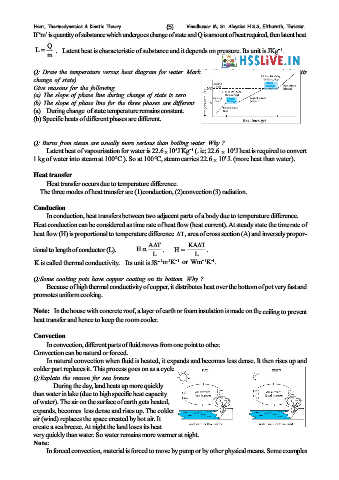
Q: Draw the temperature versus heat diagram for water. Mark the three phases of water (including its
change of state).
Give reasons for the following
(a) The slope of phase line during change of state is zero.
(b) The slope of phase line for the three phases are different.
(a) During change of state temperature remains constant.
(b) Specific heats of different phases are different.
Q: Burns from steam are usually more serious than boiling water. Why ?
-1
5
5
Latent heat of vapourisation for water is 22.6 10 J Kg (. ie; 22.6 10 J heat is required to convert
5
O
O
1 kg of water into steam at 100 C ). So at 100 C, steam carries 22.6 10 J. (more heat than water).
Heat transfer
Heat transfer occurs due to temperature difference.
The three modes of heat transfer are (1)conduction, (2)convection (3) radiation.
Conduction
In conduction, heat transfers between two adjacent parts of a body due to temperature difference.
Heat conduction can be considered as time rate of heat flow (heat current). At steady state the time rate of
heat flow (H) is proportional to temperature difference T, area of cross section (A) and inversely propor-
A T KA T
tional to length of conductor (L). H . H = .
L L
-1 -1
-1 -1
-1
K is called thermal conductivity. Its unit is JS m K or Wm K .
Q:Some cooking pots have copper coating on its bottom. Why ?
Because of high thermal conductivity of copper, it distributes heat over the bottom of pot very fast and
promotes uniform cooking.
Note: In the house with concrete roof, a layer of earth or foam insulation is made on the ceiling to prevent
heat transfer and hence to keep the room cooler.
Convection
In convection, different parts of fluid moves from one point to other.
Convection can be natural or forced.
In natural convection when fluid is heated, it expands and becomes less dense. It then rises up and
colder part replaces it. This process goes on as a cycle.
Q:Explain the reason for sea breeze
During the day, land heats up more quickly
than water in lake (due to high specific heat capacity
of water). The air on the surface of earth gets heated,
expands, becomes less dense and rises up. The colder
air (wind) replaces the space created by hot air. It
create a sea breeze. At night the land loses its heat
very quickly than water. So water remains more warmer at night.
Note:
In forced convection, material is forced to move by pump or by other physical means. Some examples

