


Page 5 - ABL Thrive Newsletter_Q2 2019
P. 5
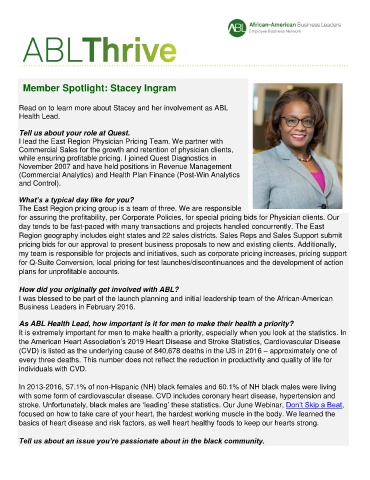
Member Spotlight: Stacey Ingram

       Read on to learn more about Stacey and her involvement as ABL
       Health Lead.

       Tell us about your role at Quest.
       I lead the East Region Physician Pricing Team. We partner with
       Commercial Sales for the growth and retention of physician clients,
       while ensuring profitable pricing. I joined Quest Diagnostics in
       November 2007 and have held positions in Revenue Management
       (Commercial Analytics) and Health Plan Finance (Post-Win Analytics
       and Control).

       What’s a typical day like for you?
       The East Region pricing group is a team of three. We are responsible
       for assuring the profitability, per Corporate Policies, for special pricing bids for Physician clients. Our
       day tends to be fast-paced with many transactions and projects handled concurrently. The East
       Region geography includes eight states and 22 sales districts. Sales Reps and Sales Support submit
       pricing bids for our approval to present business proposals to new and existing clients. Additionally,
       my team is responsible for projects and initiatives, such as corporate pricing increases, pricing support
       for Q-Suite Conversion, local pricing for test launches/discontinuances and the development of action
       plans for unprofitable accounts.

       How did you originally get involved with ABL?
       I was blessed to be part of the launch planning and initial leadership team of the African-American
       Business Leaders in February 2016.

       As ABL Health Lead, how important is it for men to make their health a priority?
       It is extremely important for men to make health a priority, especially when you look at the statistics. In
       the American Heart Association’s 2019 Heart Disease and Stroke Statistics, Cardiovascular Disease
       (CVD) is listed as the underlying cause of 840,678 deaths in the US in 2016 – approximately one of
       every three deaths. This number does not reflect the reduction in productivity and quality of life for
       individuals with CVD.

       In 2013-2016, 57.1% of non-Hispanic (NH) black females and 60.1% of NH black males were living
       with some form of cardiovascular disease. CVD includes coronary heart disease, hypertension and
       stroke. Unfortunately, black males are ‘leading’ these statistics. Our June Webinar, Don’t Skip a Beat,
       focused on how to take care of your heart, the hardest working muscle in the body. We learned the
       basics of heart disease and risk factors, as well heart healthy foods to keep our hearts strong.

       Tell us about an issue you’re passionate about in the black community.

