


Page 144 - Class-11-Physics-Part-1_Neat
P. 144
130                                                                                    PHYSICS


                                                    An experiment on head-on collision

                          In performing an experiment on collision on a horizontal surface, we face three difficulties.
                          One, there will be friction and bodies will not travel with uniform velocities. Two, if two bodies
                          of different sizes collide on a table, it would be difficult to arrange them for a head-on collision
                          unless their centres of mass are at the same height above the surface. Three, it will be fairly
                          difficult to measure velocities of the two bodies just before and just after collision.
                             By performing this experiment in a vertical direction, all the three difficulties vanish. Take
                          two balls, one of which is heavier (basketball/football/volleyball) and the other lighter (tennis
                          ball/rubber ball/table tennis ball). First take only the heavier ball and drop it vertically from
                          some height, say 1 m. Note to which it rises. This gives the velocities near the floor or ground,
                                                                       2
                          just before and just after the bounce (by using v = 2gh ). Hence you
                          will get the coefficient of restitution.
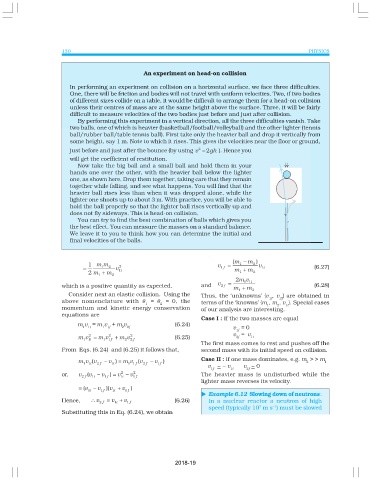
                             Now take the big ball and a small ball and hold them in your
                          hands one over the other, with the heavier ball below the lighter
                          one, as shown here. Drop them together, taking care that they remain
                          together while falling, and see what happens. You will find that the
                          heavier ball rises less than when it was dropped alone, while the
                          lighter one shoots up to about 3 m. With practice, you will be able to
                          hold the ball properly so that the lighter ball rises vertically up and
                          does not fly sideways. This is head-on collision.
                             You can try to find the best combination of balls which gives you
                          the best effect. You can measure the masses on a standard balance.
                          We leave it to you to think how you can determine the initial and
                          final velocities of the balls.


                                                                                   (m −  m  )
                                1 m m                                         v   =   1    2  v
                              =      1  2  v  2                                1 f  m +  m    1i                (6.27)
                                2 m +  m  2  1i                                       1    2
                                    1
                                                                                    2m v
                                                                                       1 1i
                                                                                  =
                       which is a positive quantity as expected.        and   v 2 f  m +  m 2                   (6.28)
                                                                                     1
                         Consider next an elastic collision.  Using the  Thus, the ‘unknowns’ {v , v } are obtained in
                       above nomenclature with θ      =  θ  =  0, the                           1f  2f
                                                    1     2             terms of the ‘knowns’ {m , m , v }. Special cases
                                                                                                1
                                                                                                   2
                                                                                                      1i
                       momentum and kinetic energy conservation         of our analysis are interesting.
                       equations are
                                                                        Case I : If the two masses are equal
                             m v  = m v  + m v                 (6.24)
                              1 1i   1 1f   2 2f                                    v  = 0
                                                                                     1f
                             m v =  m v 2  +  m v  2           (6.25)               v  =  v 1i
                                2
                                                                                     2f
                                      1 1 f
                               1 1i
                                             2 2 f
                                                                        The first mass comes to rest and pushes off the
                       From  Eqs. (6.24)  and (6.25) it follows that,   second mass with its initial speed on collision.
                             m v  (v  −  v  ) =  m v  (v  −  v  )       Case II : If one mass dominates, e.g. m  > > m 1
                                                                                                              2
                               1 1i  2 f  1i  1 1 f  2 f  1 f
                                                                           v   ~ − v       v  ~ 0
                                                                            1f     1i   2f
                                            2
                       or,   v  (v −  v  ) =  v −  v 2                  The heavier mass is undisturbed while the
                              2 f  1i  1 f  1i  1 f
                                                                        lighter mass reverses its velocity.
                             =  (v −  v 1 f  )(v +  v 1 f  )
                                         1i
                                1i
                                                                           Example 6.12  Slowing down of neutrons:
                                                                          t
                       Hence,    ∴ v 2 f  =  v +  v 1 f        (6.26)      In a nuclear reactor a neutron of high
                                         1i
                                                                           speed (typically 10  m s ) must be slowed
                                                                                                  –1
                                                                                             7
                       Substituting this in Eq. (6.24), we obtain
                                                               2018-19

