


Page 143 - Class-11-Physics-Part-1_Neat
P. 143
WORK, ENERGY AND POWER 129
Answer The downward force on the elevator is by the second particle. F is likewise the force
21
exerted on the second particle by the first particle.
F = m g + F = (1800 × 10) + 4000 = 22000 N
f Now from Newton’s third law, F = − F . This
The motor must supply enough power to balance implies 12 21
this force. Hence,
∆p + ∆p = 0
P = F. v = 22000 × 2 = 44000 W = 59 hp t 1 2
The above conclusion is true even though the
6.12 COLLISIONS forces vary in a complex fashion during the
In physics we study motion (change in position). collision time ∆t. Since the third law is true at
At the same time, we try to discover physical every instant, the total impulse on the first object
quantities, which do not change in a physical is equal and opposite to that on the second.
process. The laws of momentum and energy On the other hand, the total kinetic energy of
conservation are typical examples. In this the system is not necessarily conserved. The
section we shall apply these laws to a commonly impact and deformation during collision may
encountered phenomena, namely collisions. generate heat and sound. Part of the initial kinetic
Several games such as billiards, marbles or energy is transformed into other forms of energy.
carrom involve collisions.We shall study the A useful way to visualise the deformation during
collision of two masses in an idealised form. collision is in terms of a ‘compressed spring’. If
Consider two masses m and m . The particle the ‘spring’ connecting the two masses regains
1 2 its original shape without loss in energy, then
m is moving with speed v , the subscript ‘i’
1 1i the initial kinetic energy is equal to the final
implying initial. We can cosider m to be at rest.
2 kinetic energy but the kinetic energy during the
No loss of generality is involved in making such
a selection. In this situation the mass m collision time ∆t is not constant. Such a collision
1 is called an elastic collision. On the other hand
collides with the stationary mass m and this
2 the deformation may not be relieved and the two
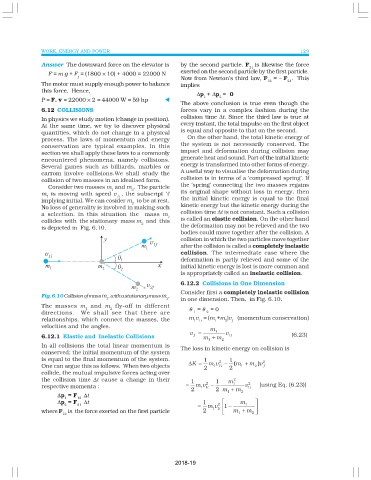
is depicted in Fig. 6.10.
bodies could move together after the collision. A
collision in which the two particles move together
after the collision is called a completely inelastic
collision. The intermediate case where the
deformation is partly relieved and some of the
initial kinetic energy is lost is more common and
is appropriately called an inelastic collision.
6.12.2 Collisions in One Dimension
Consider first a completely inelastic collision
Fig. 6.10 Collision of mass m , with a stationary mass m .
1 2 in one dimension. Then, in Fig. 6.10,
The masses m and m fly-off in different
1 2 θ = θ = 0
directions. We shall see that there are 1 2
relationships, which connect the masses, the m v = (m +m )v (momentum conservation)
1
2
f
1 1i
velocities and the angles. m
v = 1 v
6.12.1 Elastic and Inelastic Collisions f m + m 1i (6.23)
1 2
In all collisions the total linear momentum is The loss in kinetic energy on collision is
conserved; the initial momentum of the system
is equal to the final momentum of the system. ∆ K = 1 2 − 1 m + 2
)
One can argue this as follows. When two objects 2 m v 2 ( 1 m v f
2
1 1i
collide, the mutual impulsive forces acting over
the collision time ∆t cause a change in their 1 2 1 m 2 2
respective momenta : = m v − 1 v [using Eq. (6.23)]
1i
1 1i
2 2 m + m 2
1
∆p = F ∆t
1 12
∆p = F ∆t 1 m
2 21 = m v 2 1 − 1
where F is the force exerted on the first particle 2 1 1i m 1 + m 2
12
2018-19

