


Page 163 - Class-11-Physics-Part-1_Neat
P. 163
SYSTEMS OF PARTICLES AND ROTATIONAL MOTION                                                 149

                problems without explicitly outlining and        where F  is the force on the particle. Let us
                justifying the procedure. We now realise that in  consider a system of n particles with masses m ,
                                                                                                             1
                earlier studies we assumed, without saying so,
                                                                 m ,...m respectively and velocities v v 2 ,.......v n
                                                                                                    ,
                                                                                                   1
                that rotational motion and/or internal motion      2    n
                                                                 respectively. The particles may be interacting
                of the particles were either absent or negligible.
                                                                 and have external forces acting on them. The
                We no longer need to do this. We have not only
                found the justification of the procedure we      linear momentum of the first particle is m v ,
                                                                                                           1 1
                followed earlier; but we also have found how to
                                                                 of the second particle is m v  and so on.
                                                                                           2
                                                                                             2
                describe and separate the translational motion
                                                                    For the system of n particles, the linear
                of (1) a rigid body which may be rotating as
                                                                 momentum of the system is defined to be the
                well,  or (2) a system of particles with all kinds
                                                                 vector sum of all individual particles of the
                of internal motion.
                                                                 system,
                                                                     P  = p  + p  +  ... + p
                                                                          1   2       n
                                                                                      +
                                                                     =  m v  +  m v  + ... m v           (7.14)
                                                                        1  1   2  2       n  n
                                                                    Comparing this with Eq. (7.8)
                                                                     P  =  M V                           (7.15)
                                                                    Thus, the total momentum of a system
                                                                 of particles is equal to the product of the
                                                                 total mass of the system and the velocity of
                                                                 its centre of mass. Differentiating Eq. (7.15)
                                                                 with respect to time,
                                                                     dP     dV
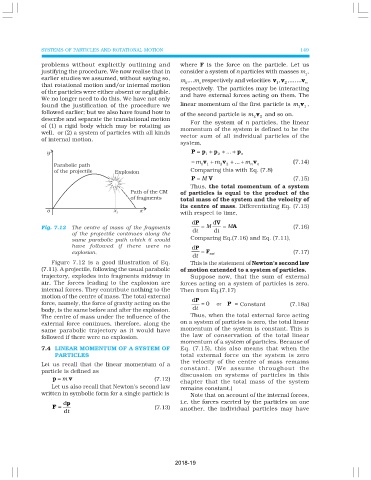
                Fig. 7.12  The centre of mass of the fragments       dt  =  M  dt  =  MA                 (7.16)
                          of the projectile continues along the
                          same parabolic path which it would        Comparing Eq.(7.16) and Eq. (7.11),
                          have followed if there were no             dP
                          explosion.                                    = F ext                          (7.17)
                                                                     dt
                   Figure 7.12 is a good illustration of Eq.        This is the statement of Newton’s second law
                (7.11). A projectile, following the usual parabolic  of motion extended to a system of particles.
                trajectory, explodes into fragments midway in       Suppose now, that the sum of external
                air. The forces leading to the explosion are     forces acting on a system of particles is zero.
                internal forces. They contribute nothing to the  Then from Eq.(7.17)
                motion of the centre of mass. The total external
                force, namely, the force of gravity acting on the    dP  =  0  or  P  = Constant        (7.18a)
                body, is the same before and after the explosion.    dt
                The centre of mass under the influence of the       Thus, when the total external force acting
                external force continues, therefore, along the   on a system of particles is zero, the total linear
                same parabolic trajectory as it would have       momentum of the system is constant. This is
                followed if there were no explosion.             the law of conservation of the total linear
                                                                 momentum of a system of particles. Because of
                7.4 LINEAR MOMENTUM OF A SYSTEM OF               Eq. (7.15), this also means that when the
                    PARTICLES                                    total external force on the system is zero
                                                                 the velocity of the centre of mass remains
                Let us recall that the linear momentum of a
                particle is defined as                           constant. (We assume throughout the
                                                                 discussion on systems of particles in this
                    p  =  m v                           (7.12)
                                                                 chapter that the total mass of the system
                   Let us also recall that Newton’s second law   remains constant.)
                written in symbolic form for a single particle is   Note that on account of the internal forces,
                       dp                                        i.e. the forces exerted by the particles on one
                    F  =                                (7.13)   another, the individual particles may have
                        dt


                                                               2018-19

