


Page 160 - Class-11-Physics-Part-1_Neat
P. 160
146                                                                                    PHYSICS

                       small, we can treat the body as a continuous         Let us consider a thin rod, whose width and
                       distribution of mass. We subdivide the body into  breath (in case the cross section of the rod is
                       n small elements of mass;  ∆m , ∆m ... ∆m ; the  rectangular) or radius (in case the cross section
                                                    1    2     n
                       th
                       i  element  ∆m is taken to be located about the  of the rod is cylindrical) is much smaller than
                                     i
                       point  (x , y , z ). The coordinates of the centre of  its length. Taking the origin to be at the
                               i  i  i
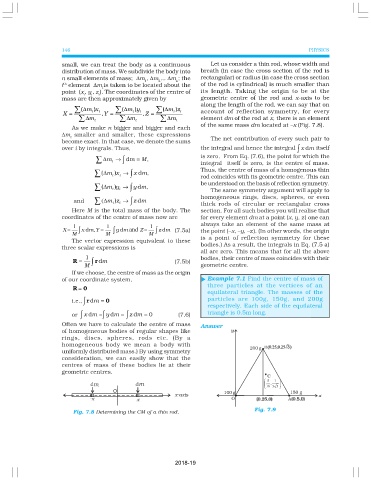
                       mass are then approximately given by             geometric centre of the rod and x-axis to be
                                                                        along the length of the rod, we can say that on
                                             ∆
                           ∑  ( m  )x     ∑ ( m  )y     ∑  ( m  )z
                              ∆
                                                           ∆
                       X =        i  i  ,Y =    i  i  ,Z =    i  i      account of reflection symmetry, for every
                             ∑ ∆ m i       ∑  ∆ m  i      ∑ ∆ m  i      element dm of the rod at x, there is an element
                                                                        of the same mass dm located at –x (Fig. 7.8).
                          As we make n bigger and bigger and each
                       ∆m  smaller and smaller, these expressions
                          i                                                 The net contribution of every such pair to
                       become exact. In that case, we denote the sums
                       over i by integrals. Thus,                       the integral and hence the integral      itself
                                   ∑  ∆m → d   m =  M,                  is zero.  From Eq. (7.6), the point for which the
                                            ∫
                                         i
                                                                        integral
                                                                                 itself is zero, is the centre of mass.
                                   ∑  (∆m  i  )x →  ∫  x m ,            Thus, the centre of mass of a homogenous thin
                                                  d
                                           i
                                                                        rod coincides with its geometric centre. This can
                                   ∑  (∆m i  )y → ∫  y m ,              be understood on the basis of reflection symmetry.
                                                  d
                                           i
                                                                            The same symmetry argument will apply to
                                                  d
                                          )
                           and     ∑ (∆m z →   ∫ z m                    homogeneous rings, discs, spheres, or even
                                         i
                                           i
                                                                        thick rods of circular or rectangular cross
                          Here M is the total mass of the body. The     section. For all such bodies you will realise that
                       coordinates of the centre of mass now are        for every element dm at a point (x, y, z) one can
                                                                        always take an element of the same mass at
                           1           1              1
                       X =   ∫  x m Y =  ∫ y m and  Z =  ∫  z m   (7.5a)  the point (–x, –y, –z). (In other words, the origin
                                                           d
                                  ,
                                            d
                               d
                           M          M               M
                                                                        is a point of reflection symmetry for these
                          The vector expression equivalent to these
                       three scalar expressions is                      bodies.) As a result, the integrals in Eq. (7.5 a)
                                                                        all are zero. This means that for all the above
                               1                                        bodies, their centre of mass coincides with their
                           R =   ∫  r m                        (7.5b)
                                    d
                               M                                        geometric centre.
                          If we choose, the centre of mass as the origin
                       of our coordinate system,                        u  Example 7.1 Find the centre of mass of
                                                                          three particles at the vertices of an
                           R  = 0
                                                                          equilateral triangle. The masses of the
                              ∫
                          i.e., r dm =  0                                 particles are 100g, 150g, and 200g
                                                                          respectively. Each side of the equilateral
                             ∫
                          or  x md  = ∫ y m =  ∫  z m = 0       (7.6)     triangle is 0.5m long.
                                        d
                                                d
                       Often we have to calculate the centre of mass    Answer
                       of homogeneous bodies of regular shapes like
                       rings, discs, spheres, rods etc. (By a
                       homogeneous body we mean a body with
                       uniformly distributed mass.) By using symmetry
                       consideration, we can easily show that the
                       centres of mass of these bodies lie at their
                       geometric centres.
                                                                                           Fig. 7.9
                           Fig. 7.8 Determining the CM of a thin rod.


                                                               2018-19

