


Page 185 - Class-11-Physics-Part-1_Neat
P. 185
SYSTEMS OF PARTICLES AND ROTATIONAL MOTION                                                 171

                   τ =  Iα                              (7.43)      I = Moment of inertia of flywheel about its
                   Eq. (7.43) is similar to Newton’s second law            MR  2
                for linear motion expressed symbolically as         axis  =
                                                                             2
                   F = ma
                                                                           ×
                   Just as force produces acceleration, torque         20.0 (0.2) 2           2
                produces angular acceleration in a body. The        =       2       = 0.4 kg m
                angular acceleration is directly proportional to    α = angular acceleration
                                                                                          2
                the applied torque and is inversely proportional       = 5.0 N m/0.4 kg m  = 12.5 s –2
                to the moment of inertia of the body. In this    (b) Work done by the pull unwinding 2m of the
                respect, Eq.(7.43) can be called Newton’s second    cord
                law for rotational motion about a fixed axis.       = 25 N × 2m = 50 J
                                                                 (c) Let ω  be the final angular velocity. The
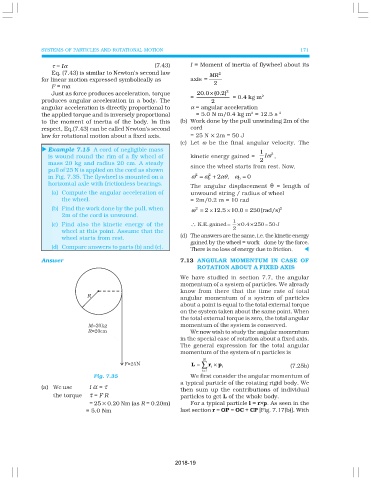
                u Example 7.15  A cord of negligible mass                                    1
                                                                                                 2
                  is wound round the rim of a fly wheel of          kinetic energy gained =    Iω ,
                                                                                             2
                  mass 20 kg and radius 20 cm. A steady
                                                                    since the wheel starts from rest. Now,
                  pull of 25 N is applied on the cord as shown
                                                                           2
                                                                      2
                  in Fig. 7.35. The flywheel is mounted on a         ω =  ω +  2αθ , ω =  0
                                                                           0         0
                  horizontal axle with frictionless bearings.       The angular displacement θ     = length of
                   (a) Compute the angular acceleration of          unwound string / radius of wheel
                       the wheel.                                   = 2m/0.2 m = 10 rad
                   (b) Find the work done by the pull, when          ω =  2 12 5 10 0 =  250(rad/s  ) 2
                                                                           ×
                                                                      2
                                                                                 ×
                                                                                     .
                                                                               .
                       2m of the cord is unwound.
                   (c) Find also the kinetic energy of the          ∴
                       wheel at this point. Assume that the
                                                                 (d) The answers are the same, i.e. the kinetic energy
                       wheel starts from rest.
                                                                    gained by the wheel = work   done by the force.
                   (d) Compare answers to parts (b) and (c).
                                                                    There is no loss of energy due to friction.   t
                Answer                                           7.13 ANGULAR MOMENTUM IN CASE OF
                                                                       ROTATION ABOUT A FIXED AXIS
                                                                 We have studied in section 7.7, the angular
                                                                 momentum of a system of particles. We already
                                                                 know from there that the time rate of total
                                                                 angular momentum of a system of particles
                                                                 about a point is equal to the total external torque
                                                                 on the system taken about the same point. When
                                                                 the total external torque is zero, the total angular
                                                                 momentum of the system is conserved.
                                                                    We now wish to study the angular momentum
                                                                 in the special case of rotation about a fixed axis.
                                                                 The general expression for the total angular
                                                                 momentum of the system of n particles is
                                                                         N
                                                                     L =  ∑ i  p i                      (7.25b)
                                                                           r ×
                                                                         i  =1
                                  Fig. 7.35                         We first consider the angular momentum of
                                                                 a typical particle of the rotating rigid body. We
                (a) We use       I α = τ
                                                                 then sum up the contributions of individual
                    the torque   τ = F R                         particles to get L of the whole body.
                                 = 25 × 0.20 Nm (as R = 0.20m)      For a typical particle l = r × p. As seen in the
                                        = 5.0 Nm                 last section r = OP = OC + CP [Fig. 7.17(b)]. With


                                                               2018-19

