


Page 184 - Class-11-Physics-Part-1_Neat
P. 184
170 PHYSICS
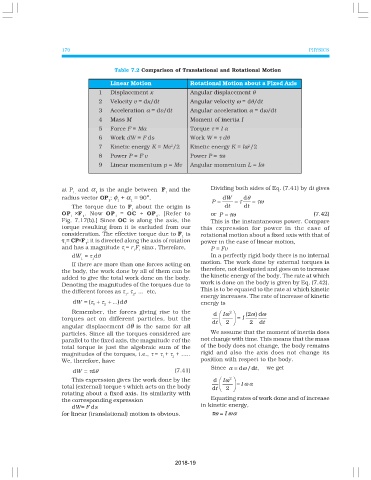
Table 7.2 Comparison of Translational and Rotational Motion
Linear Motion Rotational Motion about a Fixed Axis
1 Displacement x Angular displacement θ
2 Velocity v = dx/dt Angular velocity ω = dθ/dt
3 Acceleration a = dv/dt Angular acceleration α = dω/dt
4 Mass M Moment of inertia I
5 Force F = Ma Torque τ = I α
6 Work dW = F ds Work W = τ dθ
2
2
7 Kinetic energy K = Mv /2 Kinetic energy K = Iω /2
8 Power P = F v Power P = τω
9 Linear momentum p = Mv Angular momentum L = Iω
at P and α is the angle between F and the Dividing both sides of Eq. (7.41) by dt gives
1, 1 1
radius vector OP ; φ + α = 90°. dW dθ
1 1 1 P = = τ = τω
The torque due to F about the origin is dt dt
1
OP × F . Now OP = OC + OP . [Refer to or P = τω (7.42)
1 1 1 1
Fig. 7.17(b).] Since OC is along the axis, the This is the instantaneous power. Compare
torque resulting from it is excluded from our this expression for power in the case of
consideration. The effective torque due to F is rotational motion about a fixed axis with that of
1
τ τ τ τ τ = CP × F ; it is directed along the axis of rotation power in the case of linear motion,
1 1
and has a magnitude τ = r F sinα , Therefore, P = Fv
1 1 1
dW = τ dθ In a perfectly rigid body there is no internal
1 1
If there are more than one forces acting on motion. The work done by external torques is
therefore, not dissipated and goes on to increase
the body, the work done by all of them can be
the kinetic energy of the body. The rate at which
added to give the total work done on the body.
work is done on the body is given by Eq. (7.42).
Denoting the magnitudes of the torques due to
This is to be equated to the rate at which kinetic
the different forces as τ , τ , … etc,
1 2
energy increases. The rate of increase of kinetic
dW = (τ + τ + ...)dθ energy is
2
1
Remember, the forces giving rise to the d Iω 2 ( ω) dω
2
torques act on different particles, but the dt 2 = I
angular displacement dθ is the same for all 2 dt
particles. Since all the torques considered are We assume that the moment of inertia does
parallel to the fixed axis, the magnitude τ of the not change with time. This means that the mass
total torque is just the algebraic sum of the of the body does not change, the body remains
magnitudes of the torques, i.e., τ = τ + τ + ..... rigid and also the axis does not change its
1 2
We, therefore, have position with respect to the body.
Since α = d /d , we get
ω
t
dW = τ dθ (7.41)
2
This expression gives the work done by the d Iω =
total (external) torque τ which acts on the body dt 2 I ω α
rotating about a fixed axis. Its similarity with
Equating rates of work done and of increase
the corresponding expression
in kinetic energy,
dW= F ds
for linear (translational) motion is obvious. τω = I ωα
2018-19

