


Page 199 - Class-11-Physics-Part-1_Neat
P. 199
GRAVITATION                                                                                185

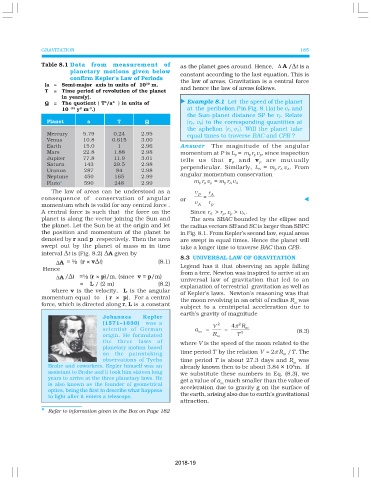
                Table 8.1 Data   from    measurement       of    as the planet goes around. Hence,   ∆ A /∆t is a
                          planetary motions given below          constant according to the last equation. This is
                          confirm Kepler’s Law of Periods        the law of areas. Gravitation is a central force
                                                     10
                 (a ≡ Semi-major  axis in units of  10  m.       and hence the law of areas follows.
                 T  ≡ Time period of revolution of the planet
                       in years(y).
                                      2
                                         3
                 Q ≡ The quotient ( T /a   ) in units of           t  Example 8.1  Let  the speed of the planet
                       10   y  m .)                                at  the  perihelion P in Fig. 8.1(a) be v P   and
                                -3
                          -34
                             2
                                                                   the Sun-planet distance SP be r P . Relate
                  Planet        a          T        Q              {r P , v P } to the corresponding quantities at
                                                                   the aphelion {r A,  v A }. Will the planet take
                  Mercury     5.79       0.24      2.95            equal times to traverse BAC and CPB ?
                  Venus       10.8       0.615     3.00
                  Earth       15.0         1       2.96          Answer     The magnitude of the angular
                  Mars        22.8       1.88      2.98          momentum at P is L p  =  m p  r p  v p , since inspection
                  Jupiter     77.8       11.9      3.01
                                                                 tells us that r p    and v p  are mutually
                  Saturn       143       29.5      2.98                                       = m p  r A  v A . From
                  Uranus       287        84       2.98          perpendicular. Similarly, L A
                  Neptune      450        165      2.99          angular momentum conservation
                  Pluto*       590        248      2.99               m p  r p  v p  = m p  r A  v A
                   The law of areas can be understood as a            v    r
                                                                       p    A
                consequence of     conservation of angular       or      =                                   t
                momentum whch is valid for any central force .        v A  r p
                A central force is such that  the force on the      Since r A    > r p ,   v p  > v A  .
                planet is along the vector joining the Sun and      The area SBAC bounded by the ellipse and
                the planet. Let the Sun be at the origin and let  the radius vectors SB and SC is larger than SBPC
                the position and momentum of the planet be       in Fig. 8.1. From Kepler’s second law, equal areas
                denoted by r and p  respectively. Then the area  are swept in equal times. Hence the planet will
                swept out by the planet of mass m in time        take a longer time to traverse BAC than CPB.
                interval ∆t is (Fig. 8.2) ∆A given by
                                                                 8.3  UNIVERSAL LAW OF GRAVITATION
                     ∆A  = ½  (r × v∆t)                  (8.1)
                 Hence                                           Legend has it that observing an apple falling
                                                                 from a tree, Newton was inspired to arrive at an
                     ∆A /∆t   =½ (r × p)/m, (since  v = p/m)     universal law of gravitation that led to an
                                       =    L / (2 m)    (8.2)   explanation of terrestrial  gravitation as well as
                   where v  is the velocity,  L  is the angular  of Kepler’s laws.  Newton’s reasoning was that
                momentum equal  to   ( r  ×  p).  For a central  the moon revolving in an orbit of radius R  was
                force, which is directed along r, L is  a constant                                       m
                                                                 subject to a centripetal acceleration due to
                                                                 earth’s gravity of magnitude
                                     Johannes       Kepler
                                     (1571–1630)     was a                    2       2
                                                                            V      4π  R m
                                     scientist of German              a m  =     =    2                   (8.3)
                                     origin. He formulated                  R m      T
                                     the   three  laws   of      where V is the speed of the moon related to the
                                     planetary motion based
                                                                                                  π
                                     on the painstaking          time period T  by the relation V =  2 R m  /T. The
                                     observations of Tycho       time period T  is about 27.3 days and R m  was
                  Brahe and coworkers. Kepler himself was an     already known then to be about 3.84 × 10 m.  If
                                                                                                         8
                  assistant to Brahe and it took him sixteen long  we substitute these numbers in Eq. (8.3), we
                  years to arrive at the three planetary laws. He  get a value of a  much smaller than the value of
                  is also known as the founder of geometrical                  m
                                                                 acceleration due to gravity g on the surface of
                  optics, being the first to describe what happens
                  to light after it enters a telescope.          the earth, arising also due to earth’s gravitational
                                                                 attraction.
                * Refer to information given in the Box on Page 182


                                                               2018-19

