


Page 198 - Class-11-Physics-Part-1_Neat
P. 198
184                                                                                    PHYSICS

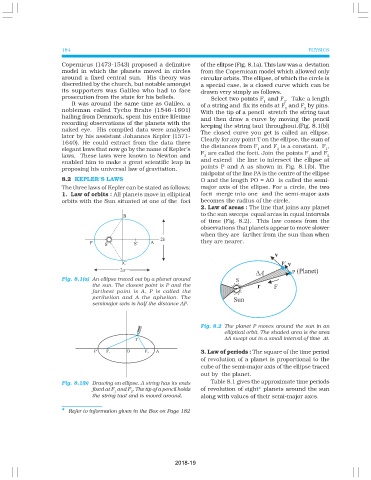
                       Copernicus (1473-1543) proposed a definitive     of the ellipse (Fig. 8.1a). This law was a  deviation
                       model in which the planets moved in circles      from the Copernican model which allowed only
                       around a fixed central sun.   His theory was     circular orbits. The ellipse, of which the circle is
                       discredited by the church, but notable amongst   a special case, is a closed curve which can be
                       its supporters was Galileo who had to face       drawn very simply as follows.
                       prosecution from the state for his beliefs.          Select two points F  and F .  Take a length
                                                                                                      2
                                                                                              1
                          It was around the same time as Galileo, a     of a string and  fix its ends at F  and F  by pins.
                                                                                                      1
                                                                                                             2
                       nobleman called Tycho Brahe (1546-1601)          With the tip of a pencil  stretch the string taut
                       hailing from Denmark, spent his entire lifetime  and then draw a curve by moving the pencil
                       recording observations of the planets with the   keeping the string taut throughout.(Fig. 8.1(b))
                       naked eye.  His compiled data were analysed      The closed curve you get is called an ellipse.
                       later by his assistant Johannes Kepler (1571-    Clearly for any point T on the ellipse, the sum of
                       1640). He could extract from the data three
                       elegant laws that now go by the name of Kepler’s  the distances from F  and F  is a constant.  F ,
                                                                                                                    1
                                                                                            1
                                                                                                   2
                       laws.  These laws were known to Newton and       F  are called the focii. Join the points F and F 2
                                                                         2
                                                                                                              1

                       enabled him to make a great scientific leap in   and extend  the line to intersect the ellipse at

                       proposing his universal law of gravitation.      points P and A as shown in Fig. 8.1(b). The
                                                                        midpoint of the line PA is the centre of the ellipse
                       8.2  KEPLER’S LAWS                               O and the length PO = AO  is called the semi-
                       The three laws of Kepler can be stated as follows:  major axis of the ellipse. For a circle, the two
                       1.  Law of orbits : All planets move in elliptical  focii  merge into one  and the semi-major axis
                       orbits with the Sun situated at one of the  foci  becomes the radius of the circle.
                                                                        2. Law of areas : The line that joins any planet
                                                                        to the sun sweeps  equal areas in equal intervals
                                             B
                                                                        of time (Fig. 8.2).  This law comes from the
                                                                        observations that planets appear to move slower
                                                                        when they are  farther from the sun than when
                                                          2b
                                 P    S         S'    A                 they are nearer.
                                             C
                                            2a
                       Fig. 8.1(a) An ellipse traced out by a planet around
                                  the sun. The closest point is P and the
                                  farthest point is A, P is called the
                                  perihelion and A the aphelion. The
                                  semimajor axis is half the distance AP.


                                                                        Fig. 8.2 The planet P moves around the sun in an
                                                                                elliptical orbit. The shaded area is the area
                                                                                ∆A swept out in a small interval of time  ∆t.

                                                                        3. Law of periods : The square of the time period
                                                                        of revolution of a planet is proportional to the
                                                                        cube of the semi-major axis of the ellipse traced
                                                                        out by  the planet.
                       Fig. 8.1(b) Drawing an ellipse. A string has its ends  Table 8.1 gives the approximate time periods
                                  fixed at F  and F . The tip of a pencil holds  of revolution of eight* planets around the sun
                                         1     2
                                  the string taut and is moved around.  along with values of their semi-major axes.
                       * Refer to information given in the Box on Page 182


                                                               2018-19

