


Page 200 - Class-11-Physics-Part-1_Neat
P. 200
186                                                                                    PHYSICS


                                                              Central Forces


                             We know the time rate of change of the angular momentum of a single particle about the origin
                             is
                               dl
                                 = × F
                                   r
                              dt
                               The angular momentum of the particle is conserved, if the torque  τ ττ τ  = r  × F  due to the
                             force F on it vanishes. This happens either when F is zero or when F is along r. We are
                             interested in forces which satisfy the latter condition. Central forces satisfy this condition.
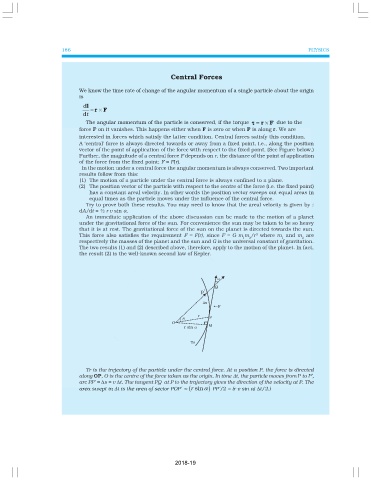
                             A ‘central’ force is always directed towards or away from a fixed point, i.e., along the position
                             vector of the point of application of the force with respect to the fixed point. (See Figure below.)
                             Further, the magnitude of a central force F depends on r, the distance of the point of application
                             of the force from the fixed point; F = F(r).
                              In the motion under a central force the angular momentum is always conserved. Two important
                             results follow from this:
                             (1) The motion of a particle under the central force is always confined to a plane.
                             (2) The position vector of the particle with respect to the centre of the force (i.e. the fixed point)
                                 has a constant areal velocity. In other words the position vector sweeps out equal areas in
                                 equal times as the particle moves under the influence of the central force.
                               Try to prove both these results. You may need to know that the areal velocity is given by :
                             dA/dt = ½ r v sin α.
                               An immediate application of the above discussion can be made to the motion of a planet
                             under the gravitational force of the sun. For convenience the sun may be taken to be so heavy
                             that it is at rest. The gravitational force of the sun on the planet is directed towards the sun.
                             This force also satisfies the requirement F = F(r), since F = G m m /r 2  where m  and m  are
                                                                                       1  2          1      2
                             respectively the masses of the planet and the sun and G is the universal constant of gravitation.
                             The two results (1) and (2) described above, therefore, apply to the motion of the planet. In fact,
                             the result (2) is the well-known second law of Kepler.


                               Tr is the trejectory of the particle under the central force. At a position P, the force is directed
                             along OP, O is the centre of the force taken as the origin. In time ∆t, the particle moves from P to P′,
                             arc PP′ = ∆s = v ∆t. The tangent PQ  at P to the trajectory gives the direction of the velocity at P. The
                             area swept in ∆t is the area of sector POP′  ( sinr≈  α ) PP′/2 = (r v sin a) ∆t/2.)


                                                               2018-19

