


Page 54 - Class-11-Physics-Part-1_Neat
P. 54
40                                                                                     PHYSICS

                       a rectangular coordinate system consisting of    with the path of the car’s motion and origin of
                       three mutually perpenducular axes, labelled  X-,  the axis as the point from where the car started
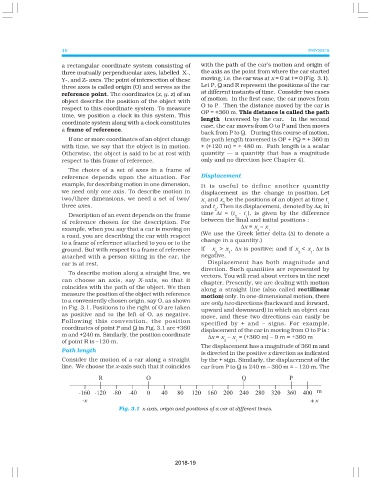
                       Y-, and Z- axes. The point of intersection of these  moving, i.e. the car was at x = 0 at t = 0 (Fig. 3.1).
                       three axes is called origin (O) and serves as the  Let P, Q and R represent the positions of the car
                                                                        at different instants of time.  Consider two cases
                       reference point. The coordinates (x, y. z) of an
                                                                        of motion.  In the first case, the car moves from
                       object describe the position of the object with
                                                                        O to P.  Then the distance moved by the car is
                       respect to this coordinate system. To measure
                                                                        OP = +360 m. This distance is called the path
                       time, we position a clock in this system. This
                                                                        length  traversed by the car.   In the second
                       coordinate system along with a clock constitutes
                                                                        case, the car moves from O to P and then moves
                       a frame of reference.
                                                                        back from P to Q.   During this course of motion,
                         If one or more coordinates of an object change  the path length traversed is OP + PQ = + 360 m
                       with time, we say that the object is in motion.  + (+120 m) = + 480 m.  Path length is a scalar
                       Otherwise, the object is said to be at rest with  quantity —  a quantity that has a magnitude
                       respect to this frame of reference.              only and no direction (see Chapter 4).
                         The choice of a set of axes in a frame of
                       reference depends upon the situation. For        Displacement
                       example, for describing motion in one dimension,  It is useful to define another quantity
                       we need only one axis. To describe motion in     displacement  as  the  change  in position. Let

                       two/three dimensions, we need a set of two/      x  and x be the positions of an object at time t
                                                                         1
                                                                                2
                       three axes.                                      and t . Then its displacement, denoted by ∆x, in 1
                                                                             2
                         Description of an event depends on the frame   time ∆t  = (t -  t ), is given by the difference
                                                                                        1
                                                                                    2
                       of reference chosen for the description. For     between the final and initial positions :
                       example, when you say that a car is moving on                           ∆x = x – x 1
                                                                                            2

                       a road, you are describing the car with respect  (We use the Greek letter delta (∆) to denote a
                       to a frame of reference attached to you or to the  change in a quantity.)
                       ground. But with respect to a frame of reference  If  x 2  > x , ∆x is positive; and if x < x , ∆x is
                                                                                  1
                                                                                                           2
                                                                                                               1
                       attached with a person sitting in the car, the   negative.
                       car is at rest.                                     Displacement has both magnitude and
                                                                        direction. Such quantities are represented by
                         To describe motion along a straight line, we
                                                                        vectors. You will read about vectors in the next
                       can choose an axis, say X-axis, so that it
                                                                        chapter. Presently, we are dealing with motion
                       coincides with the path of the object. We then
                                                                        along a straight line (also called rectilinear
                       measure the position of the object with reference
                                                                        motion) only. In one-dimensional motion, there
                       to a conveniently chosen origin, say O, as shown
                                                                        are only two directions (backward and forward,
                       in Fig. 3.1. Positions to the right of O are taken
                                                                        upward and downward) in which an object can
                       as positive and to the left of O, as negative.
                                                                        move, and these two directions can easily be
                       Following this convention, the position
                                                                        specified by + and – signs. For example,
                       coordinates of point P and Q in Fig. 3.1 are +360
                                                                        displacement of the car in moving from O to P is :
                       m and +240 m. Similarly, the position coordinate
                                                                           ∆x = x  – x  = (+360 m) – 0 m = +360 m
                       of point R is –120 m.                                    2   1
                                                                        The displacement has a magnitude of 360 m and
                       Path length
                                                                        is directed in the positive x direction as indicated
                       Consider the motion of a car along a straight    by the + sign. Similarly, the displacement of the
                       line.  We choose the x-axis such that it coincides  car from P to Q is 240 m – 360 m = – 120 m. The
                                           Fig. 3.1  x-axis, origin and positions of a car at different times.


                                                               2018-19

