


Page 59 - Class-11-Physics-Part-1_Neat
P. 59
MOTION IN A STRAIGHT LINE                                                                   45

                                                                 This led to the concept of acceleration as the rate
                  Example 3.2    The position of an object
                 t
                  moving along x-axis is given by   x = a + bt 2  of change of velocity with time.
                                                 –2
                  where  a = 8.5 m, b = 2.5 m s  and t is           The average acceleration a     over a time
                  measured in seconds. What is its velocity at   interval is defined as the change of velocity
                  t = 0 s and t = 2.0 s. What is the average     divided by the time interval :
                  velocity between t = 2.0 s and t = 4.0 s ?                                ∆
                                                                              a =  v 2  – v 1  =  v       (3.4)
                                                                                   t  – t    t ∆
                Answer  In notation of differential calculus, the                   2  1
                velocity is                                      where v  and v  are the instantaneous velocities
                                                                               1
                                                                        2
                                                                 or simply velocities at time  t and t . It is the
                        d x  d      2              -1                                         2     1

                     v =   =   ( a + bt  ) =  2b t = 5.0 t  m s  average change of velocity per unit time. The SI


                          t d  t d                                                        –2
                                        –1
                At   t = 0 s,      v = 0 m s    and at   t = 2.0 s,  unit of acceleration is m s  .
                                                                   On a plot of velocity versus time, the average
                v = 10 m s  .                                    acceleration is the slope of the straight line
                          -1
                                        )
                                  x  (4.0 −  x  (2.0 )
                Average velocity =                               connecting the points corresponding to (v , t )
                                                                                                             2
                                                                                                          2
                                     4.0 −  2.0                  and (v , t ). The average acceleration
                                                                             1
                                                                         1
                                  a + 16 – a  – 4b               for     velocity-time graph shown in Fig. 3.7 for
                                        b
                                    =             =  6.0 b
                                                        ×
                                        2.0                      different time intervals 0 s - 10 s, 10 s – 18 s,
                                    6.0 2.5 =15 m s=  ×  -1              t  and 18 s – 20 s are :
                  From Fig. 3.7, we note that during the period                 (24 – 0 m s  –1
                                                                                       )
                t =10 s to 18 s the velocity is constant. Between  0 s - 10 s  a =      )    =  2.4 m s  –2
                period t =18 s to t = 20 s, it is uniformly                       (10 – 0 s
                decreasing  and  during  the  period t = 0 s to     t                    )   –1
                = 10 s, it is increasing. Note that for uniform              a =  (24 – 24 m s  =  0 m s  –2
                                                                 10 s - 18 s              )
                motion, velocity is the same as the average                        (18 – 10 s
                velocity at all instants.
                                                                                        )
                  Instantaneous speed or simply speed is the                  a =  (0 – 24 m s  –1  =    –2
                                                                 18 s - 20 s                     – 12 m s
                                                                                          )
                magnitude of velocity. For example, a velocity of                  (20 – 18 s
                                                     –1
                          –1
                + 24.0 m s  and a velocity of – 24.0 m s  — both
                                                  -1
                have an associated speed of 24.0 m s .  It should
                be noted that though average speed over a finite
                interval of time is greater or equal to the
                magnitude     of   the   average    velocity,
                instantaneous speed at an instant is equal to
                the magnitude of the instantaneous velocity at       a (m s –2 )
                that instant. Why so ?
                3.5  ACCELERATION
                The velocity of an object, in general, changes
                during its course of motion. How to describe this
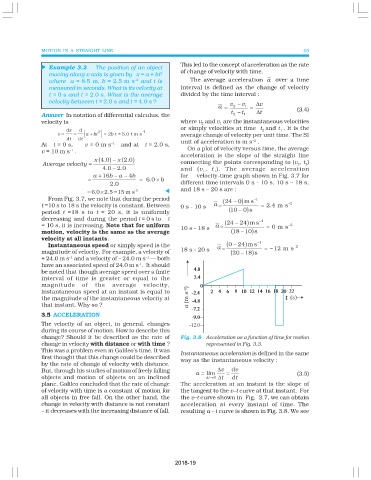
                change? Should it be described as the rate of    Fig. 3.8 Acceleration as a function of time for motion
                change in velocity with distance or with time ?           represented in Fig. 3.3.
                This was a problem even in Galileo’s time. It was
                                                                 Instantaneous acceleration is defined in the same
                first thought that this change could be described
                                                                 way as the instantaneous velocity :
                by the rate of change of velocity with distance.
                But, through his studies of motion of freely falling  a =  lim  ∆ v  =  dv                (3.5)
                objects and motion of objects on an inclined               t ∆ → ∆ t  dt
                                                                             0
                plane, Galileo concluded that the rate of change  The acceleration at an instant is the slope of
                of velocity with time is a constant of motion for  the tangent to the v–t curve at that instant.  For
                all objects in free fall. On the other hand, the  the v–t curve shown in  Fig.  3.7, we can obtain
                change in velocity with distance is not constant  acceleration at every instant of time. The
                – it decreases with the increasing distance of fall.  resulting a – t curve is shown in Fig. 3.8. We see


                                                               2018-19

