


Page 57 - Class-11-Physics-Part-1_Neat
P. 57
MOTION IN A STRAIGHT LINE                                                                   43

                is equal to the average speed.  This is not always  3.4  INSTANTANEOUS VELOCITY AND SPEED
                the case, as you will see in the following example.
                                                                 The average velocity tells us how fast an object
                                                                 has been moving over a given time interval but
                  Example 3.1 A car is moving along a            does not tell us how fast it moves at different
                  t
                  straight line, say OP in Fig. 3.1.  It moves   instants of time during that interval.  For this,
                  from O to P in 18 s and returns from P to Q    we define  instantaneous velocity   or simply
                  in 6.0 s.  What are the average velocity       velocity v at an instant t.
                  and average speed of the car in going (a)        The velocity at an instant is defined as the
                  from O to P ? and (b) from O to P and back     limit of the average velocity as the time interval
                  to Q ?
                                                                 ∆t becomes infinitesimally small. In other words,
                                                                              ∆ x
                Answer    (a)
                                                                   v =  lim                              (3.3a)
                                   Displacement                        ∆  t →  0 ∆ t
                    Average velocity =
                                   Time interval                       dx
                                                                      =                                  (3.3b)
                                                                       dt
                                 + 360 m            −
                              v =         = +  20 m s  1         where the symbol   lim   stands for the operation
                                   18 s                                             t ∆ → 0
                                                                 of taking limit as  ∆tg0  of the quantity on its
                                    Path length                  right. In the language of calculus, the quantity
                      Average speed  =
                                   Time interval                 on the right hand side of Eq. (3.3a) is the
                                                                 differential coefficient of x with respect to t and
                                 360 m          − 1                             dx
                                      =  =  20 m s               is denoted by      (see Appendix 3.1).  It is the
                                  18 s                                           dt
                                                                 rate of change of position with respect to time,
                Thus, in this case the average speed is equal to
                the magnitude of the average velocity.           at that instant.
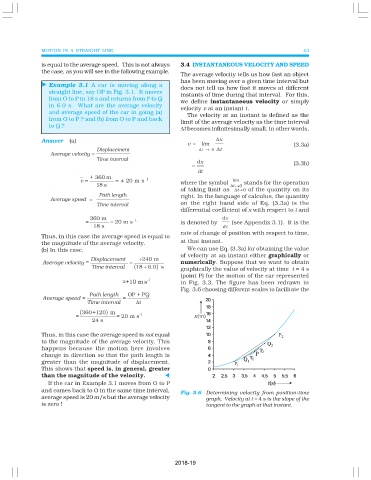
                (b) In this case,                                  We can use Eq. (3.3a) for obtaining the value
                                                                 of velocity at an instant either graphically or
                                 Displacement     + 240 m
                Average velocity =             =                 numerically. Suppose that we want to obtain
                                 Time interval   (18 +  6.0 )  s  graphically the value of velocity at time  t = 4 s
                                                                 (point P) for the motion of the car represented
                                                       =+10 ms -1  in Fig. 3.3. The figure has been redrawn in
                                                                 Fig. 3.6 choosing different scales to facilitate the
                                 Path length  OP + PQ
                Average speed =             =
                                Time interval     t ∆
                                       )
                             (360+120  m          -1
                            =             = 20 m s
                                  24 s
                Thus, in this case the average speed is not equal
                to the magnitude of the average velocity. This
                happens because the motion here involves
                change in direction so that the path length is
                greater than the magnitude of displacement.
                This shows that speed is, in general, greater
                than the magnitude of the velocity.        t
                  If the car in Example 3.1 moves from O to P
                and comes back to O in the same time interval,   Fig. 3.6 Determining velocity from position-time
                average speed is 20 m/s but the average velocity          graph.  Velocity at t = 4 s is the slope of the
                is zero !                                                 tangent to the graph at that instant.


                                                               2018-19

