


Page 56 - Class-11-Physics-Part-1_Neat
P. 56
42                                                                                     PHYSICS

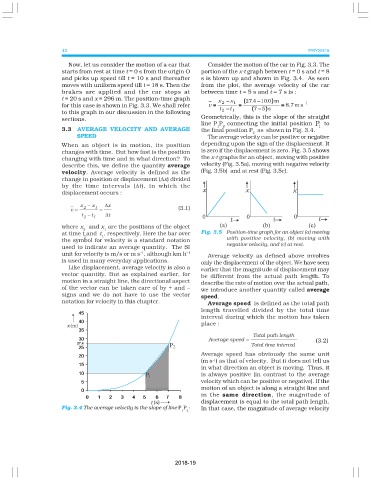
                         Now, let us consider the motion of a car that     Consider the motion of the car in Fig. 3.3. The
                       starts from rest at time t = 0 s from the origin O  portion of the x-t graph between t = 0 s and t = 8
                       and picks up speed till t = 10 s and thereafter  s is blown up and shown in Fig. 3.4.  As seen
                       moves with uniform speed till t = 18 s. Then the  from the plot, the average velocity of the car
                       brakes are applied and the car stops at          between time t = 5 s and t = 7 s is :
                       t = 20 s and x = 296 m. The position-time graph        x 2 −− − x 1  ( (( (27. 4 − −− − 10. 0 ) )) ) m
                                                                                 −

                       for this case is shown in Fig. 3.3. We shall refer  v  = = = =  = = = =       = = = =  8.7   m  s – 1
                                                                                 −
                                                                               t 2 −− − t 1  ( (( (7 − −− −  5 ) )) ) s
                       to this graph in our discussion in the following
                       sections.                                        Geometrically, this is the slope of the straight
                                                                        line P P 2  connecting the initial position P 1  to
                                                                              1
                       3.3  AVERAGE VELOCITY AND AVERAGE                the final position P as shown in Fig. 3.4.
                                                                                           2


                            SPEED                                          The average velocity can be positive or negative
                       When an object is in motion, its position        depending upon the sign of the displacement. It
                       changes with time.  But how fast is the position  is zero if the displacement is zero. Fig. 3.5 shows
                       changing with time and in what direction?  To    the x-t graphs for an object, moving with positive
                       describe this, we define the quantity average    velocity (Fig. 3.5a), moving with negative velocity
                       velocity. Average velocity is defined as the     (Fig. 3.5b)  and at rest (Fig. 3.5c).
                       change in position or displacement (∆x) divided
                       by the time intervals (∆t), in which the
                       displacement occurs :
                             x −  x   ∆ x
                             v =  2  1  =                       (3.1)
                              t −  t   t ∆
                               2  1
                       where x   and x  are the positions of the object
                               2      1
                       at time t and  t , respectively. Here the bar over  Fig. 3.5 Position-time graph for an object (a) moving
                               2     1                                           with positive velocity, (b) moving with
                       the symbol for velocity is a standard notation
                       used to indicate an average quantity.  The SI             negative velocity, and (c) at rest.
                                                   –1
                       unit for velocity is m/s or m s , although km h –1  Average velocity as defined above involves
                       is used in many everyday applications.           only the displacement of the object. We have seen
                         Like displacement, average velocity is also a  earlier that the magnitude of displacement may
                       vector quantity. But as explained earlier, for   be different from the actual path length. To
                       motion in a straight line, the directional aspect  describe the rate of motion over the actual path,
                       of the vector can be taken care of by + and –    we introduce another quantity called average
                       signs and we do not have to use the vector       speed.
                       notation for velocity in this chapter.              Average speed  is defined as the total path
                                                                        length travelled divided by the total time
                                                                        interval during which the motion has taken
                                                                        place :

                                                                                           Total path length
                                                                           Average speed =                        (3.2)
                                                                                          Total time interval
                                                                        Average speed has obviously the same unit
                                                                        (m s ) as that of velocity.  But it does not tell us
                                                                            –1
                                                                        in what direction an object is moving.  Thus, it
                                                                        is always positive (in contrast to the average
                                                                        velocity which can be positive or negative). If the
                                                                        motion of an object is along a straight line and
                                                                        in the  same direction, the magnitude of
                                                                        displacement is equal to the total path length.
                       Fig. 3.4 The average velocity is the slope of line P P .  In that case, the magnitude of average velocity
                                                                 1  2


                                                               2018-19

