


Page 65 - Class-11-Physics-Part-1_Neat
P. 65
MOTION IN A STRAIGHT LINE                                                                   51

                initial velocity increases the stopping distance
                by a factor of 4 (for the same deceleration).
                  For  the car of a particular make, the braking
                distance was found to be 10 m, 20 m, 34 m and
                50 m corresponding to velocities of 11, 15, 20   Or,
                and 25 m/s which are nearly consistent with                                      –2
                the above formula.                               Given d = 21.0 cm and g = 9.8 m s  the reaction
                                                                 time is
                  Stopping distance is an important factor
                considered in setting speed limits, for example,                                             t
                in school zones.                           t

                                                                 3.7  RELATIVE VELOCITY
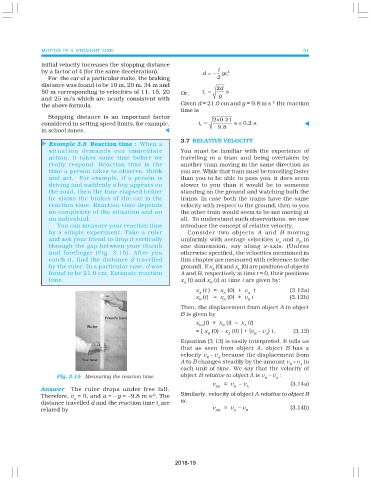
                  Example 3.8  Reaction time :  When a
                  t
                  situation   demands     our  immediate         You must be familiar with the experience of
                  action, it takes some time before we           travelling in a train and being overtaken by
                  really respond. Reaction time is the           another train moving in the same direction as
                  time a person takes to observe, think          you are. While that train must be travelling faster
                  and act.  For example, if a person is          than you to be able to pass you, it does seem
                  driving and suddenly a boy appears on          slower to you than it would be to someone
                  the road, then the time elapsed before         standing on the ground and watching both the
                  he slams the brakes of the car is the          trains. In case both the trains have the same
                  reaction time. Reaction time depends           velocity with respect to the ground, then to you
                  on complexity of the situation and on          the other train would seem to be not moving at
                  an individual.                                 all.  To understand such observations, we now
                     You can measure your reaction time          introduce the concept of relative velocity.
                  by a simple experiment. Take a ruler             Consider two objects A      and B moving
                  and ask your friend to drop it vertically      uniformly with average velocities v  and v  in
                                                                                                    A      B
                  through the gap between your thumb             one dimension, say along x-axis. (Unless
                  and forefinger (Fig. 3.15). After you          otherwise specified, the velocities mentioned in
                  catch it, find the distance d travelled        this chapter are measured with reference to the
                  by the ruler. In a particular case, d was      ground). If x  (0) and x  (0) are positions of objects
                                                                            A        B
                  found to be 21.0 cm. Estimate reaction         A and B, respectively at time t = 0, their positions
                  time.                                          x  (t) and x  (t) at time t are given by:
                                                                  A        B
                                                                      x  (t )  =  x  (0)  +  v   t       (3.12a)
                                                                        A       A        A
                                                                      x  (t)   =  x  (0)  +  v  t                (3.12b)
                                                                        B       B        B
                                                                 Then, the displacement from object A to object
                                                                 B is given by
                                                                      x (t)  =  x  (t)  –  x  (t)
                                                                        BA      B      A
                                                                      = [ x  (0) – x  (0) ] + (v  – v ) t.       (3.13)
                                                                           B      A        B   A
                                                                 Equation (3.13) is easily interpreted. It tells us
                                                                 that as seen from object A, object B    has a
                                                                 velocity v – v  because the displacement from
                                                                          B   A
                                                                 A to B changes steadily by the amount v – v  in
                                                                                                        B   A
                                                                 each unit of time. We say that the velocity of
                     Fig. 3.15   Measuring the reaction time.    object B relative to object A is v  – v  :
                                                                                               B
                                                                                                   A
                                                                            v   =  v  – v A             (3.14a)
                                                                             BA
                                                                                    B
               Answer     The ruler drops under free fall.
                                                       –2
               Therefore, v  = 0, and a = – g = –9.8 m s . The   Similarly, velocity of object A relative to object B
                           o
               distance travelled d and the reaction time t  are  is:
                                                         r
               related by                                                   v   =  v  – v B             (3.14b)
                                                                             AB
                                                                                    A


                                                               2018-19

