


Page 60 - Class-11-Physics-Part-1_Neat
P. 60
46                                                                                     PHYSICS

                       that the acceleration is nonuniform over the        (b) An object is moving in positive direction
                       period  0 s to 10 s. It is zero between 10 s and        with a negative acceleration, for example,
                       18 s and is constant with value –12 m s     –2          motion of the car in Fig 3.3 between
                       between 18 s and 20 s. When the acceleration            t = 18 s and 20 s.
                       is uniform, obviously, it equals the average        (c) An object is moving in negative direction
                       acceleration over that period.                          with a negative acceleration, for example
                         Since velocity is a quantity having both              the motion of a car moving from O in Fig.
                       magnitude and direction, a change in velocity           3.1 in negative x-direction with
                       may involve either or both of these factors.            increasing speed.
                       Acceleration, therefore, may result from a          (d) An object is moving in positive direction
                       change in speed (magnitude), a change in                till time t , and then turns back with the
                                                                                       1
                       direction or changes in both.   Like velocity,          same negative acceleration, for example
                       acceleration can also be positive, negative or          the motion of a car from point O to point
                       zero.  Position-time graphs for motion with             Q in Fig. 3.1 till time t  with decreasing
                                                                                                     1
                       positive, negative and zero acceleration are            speed and turning back and moving with
                       shown in Figs. 3.9 (a), (b) and (c), respectively.      the same negative acceleration.
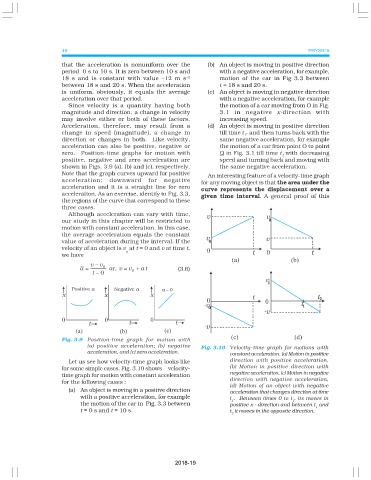
                       Note that the graph curves upward for positive      An interesting feature of a velocity-time graph
                       acceleration;    downward      for  negative     for any moving object is that the area under the
                       acceleration and it is a straight line for zero  curve represents the displacement over a
                       acceleration. As an exercise, identify in Fig. 3.3,  given time interval.  A general proof of this
                       the regions of the curve that correspond to these
                       three cases.
                         Although acceleration can vary with time,
                       our study in this chapter will be restricted to
                       motion with constant acceleration. In this case,
                       the average acceleration equals the constant
                       value of acceleration during the interval. If the
                       velocity of an object is v  at t = 0 and v at time t,
                                              o
                       we have
                                 v −  v
                                  a =  0     or,  v =  v +  a t  (3.6)
                                  t −  0        0


                       Fig. 3.9 Position-time graph for motion with
                                (a) positive acceleration; (b) negative  Fig. 3.10 Velocity–time graph for motions with
                                acceleration, and (c) zero acceleration.
                                                                                  constant acceleration. (a) Motion in positive
                         Let us see how velocity-time graph looks like            direction with positive acceleration,
                       for some simple cases. Fig. 3.10 shows     velocity-       (b) Motion in positive direction with
                                                                                  negative acceleration, (c) Motion in negative
                       time graph for motion with constant acceleration
                                                                                  direction with negative acceleration,
                       for the following cases :
                                                                                  (d) Motion of an object with negative
                         (a) An object is moving in a positive direction          acceleration that changes direction at time
                              with a positive acceleration, for example           t .  Between times 0 to t , its moves in
                                                                                   1                     1
                              the motion of the car in  Fig. 3.3 between          positive x - direction and between t  and
                                                                                                                 1
                              t = 0 s and t = 10 s.                               t  it moves in the opposite direction.
                                                                                   2


                                                               2018-19

