


Page 61 - Class-11-Physics-Part-1_Neat
P. 61
MOTION IN A STRAIGHT LINE 47
statement requires use of calculus. We can, 1
v
however, see that it is true for the simple case of = ( –v 0 )t + v t
0
an object moving with constant velocity u. Its 2
velocity-time graph is as shown in Fig. 3.11.
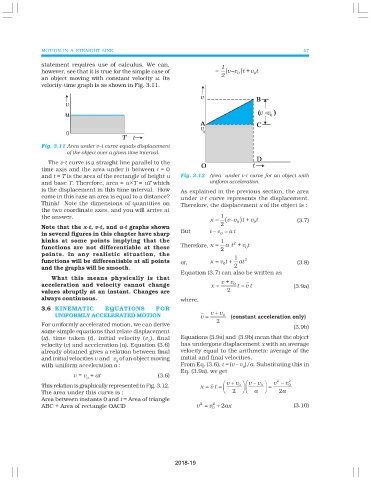
Fig. 3.11 Area under v–t curve equals displacement
of the object over a given time interval.
The v-t curve is a straight line parallel to the
time axis and the area under it between t = 0
and t = T is the area of the rectangle of height u Fig. 3.12 Area under v-t curve for an object with
and base T. Therefore, area = u × T = uT which uniform acceleration.
is the displacement in this time interval. How As explained in the previous section, the area
come in this case an area is equal to a distance? under v-t curve represents the displacement.
Think! Note the dimensions of quantities on Therefore, the displacement x of the object is :
the two coordinate axes, and you will arrive at
the answer. 1
x = ( –v v 0 )t + v t (3.7)
0
2
Note that the x-t, v-t, and a-t graphs shown
But v − v = a t
in several figures in this chapter have sharp 0
kinks at some points implying that the 1 2
functions are not differentiable at these Therefore, x = 2 a t + v t
0
points. In any realistic situation, the 1
functions will be differentiable at all points or, x = v t + at 2 (3.8)
0
and the graphs will be smooth. 2
Equation (3.7) can also be written as
What this means physically is that
v + v
=
acceleration and velocity cannot change x = 0 t v t (3.9a)
values abruptly at an instant. Changes are 2
always continuous. where,
3.6 KINEMATIC EQUATIONS FOR v +
UNIFORMLY ACCELERATED MOTION v = v 0 (constant acceleration only)
2
For uniformly accelerated motion, we can derive (3.9b)
some simple equations that relate displacement
(x), time taken (t), initial velocity (v ), final Equations (3.9a) and (3.9b) mean that the object
0
velocity (v) and acceleration (a). Equation (3.6) has undergone displacement x with an average
already obtained gives a relation between final velocity equal to the arithmetic average of the
and initial velocities v and v of an object moving initial and final velocities.
0
with uniform acceleration a : From Eq. (3.6), t = (v – v )/a. Substituting this in
0
Eq. (3.9a), we get
v = v + at (3.6)
0
2
v + v v − v v − v 2
This relation is graphically represented in Fig. 3.12. x = v t = 0 0 = 0
The area under this curve is : 2 a 2 a
Area between instants 0 and t = Area of triangle
2
2
ABC + Area of rectangle OACD v = v + 2ax (3.10)
0
2018-19

