


Page 63 - Class-11-Physics-Part-1_Neat
P. 63
MOTION IN A STRAIGHT LINE                                                                   49

                                                                       0 = 25  +20 t  + (½)  (-10) t 2
                                                                          2
                                                                 Or,    5t  – 20t  – 25  =  0
                                                                 Solving this quadratic equation for t, we get
                                                                        t = 5s
                                                                 Note that the second method is better since we
                                                                 do not have to worry about the path of the motion
                                                                 as the motion is under constant acceleration.
                                                                                                           t


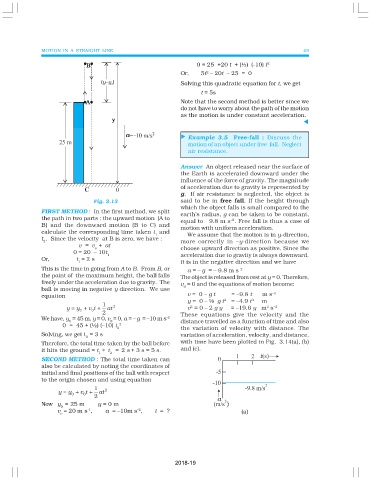
                                                                    Example 3.5     Free-fall : Discuss the
                                                                   t
                                                                    motion of an object under free  fall.  Neglect
                                                                    air resistance.

                                                                 Answer  An object released near the surface of
                                                                 the Earth is accelerated downward under the
                                                                 influence of the force of gravity. The magnitude
                                                                 of acceleration due to gravity is represented by
                                                                 g.  If air resistance is neglected, the object is
                                  Fig. 3.13                      said to be in free fall.  If the height through
                                                                 which the object falls is small compared to the
                FIRST METHOD :  In the first method, we split    earth’s radius, g can be taken to be constant,
                the path in two parts : the upward motion  (A to  equal to   9.8 m s . Free fall is thus a case of
                                                                                   –2
                B) and the downward motion (B to C) and          motion with uniform acceleration.
                calculate the corresponding time taken t  and
                                                        1          We assume that the motion is in y-direction,
                t .  Since the velocity  at B is zero, we have :
                2                                                more correctly in –y-direction because we
                                    v  =  v  +  at
                                   o                             choose upward direction as positive. Since the
                           0 = 20  – 10t
                                       1                         acceleration due to gravity is always downward,
                Or,             t = 2 s
                             1                                   it is in the negative direction and we have
                This is the time in going from A to B.  From B, or  a = – g  = – 9.8 m s –2
                the point of  the maximum height, the ball falls  The object is released from rest at y = 0. Therefore,
                freely under the acceleration due to gravity.  The  v  = 0 and the equations of motion become:
                ball is moving in negative y direction.  We use   0
                equation                                           v =  0 – g t        = –9.8 t      m s –1
                                                                   y =  0 – ½  g t    = –4.9 t      m
                                                                                2
                                                                                          2
                                     1   2
                             y =  y + v t +  at                    v  = 0 – 2 g y     = –19.6 y   m  s –2
                                                                                                2
                                                                    2
                                 0
                             0
                                     2                           These equations give the velocity and the
                We have, y  = 45 m, y = 0, v  = 0, a = – g  = –10 m s –2
                         0              0                        distance travelled as a function of time and also
                        0  =  45 + (½) (–10) t  2
                                           2                     the variation of velocity with distance. The
                Solving, we get t  = 3 s                         variation of acceleration, velocity, and distance,
                               2
                Therefore, the total time taken by the ball before  with time have been plotted in Fig.  3.14(a), (b)
                it hits the ground = t + t   = 2 s + 3 s = 5 s.  and (c).
                                    1      2
                SECOND METHOD : The total time taken can
                also be calculated by noting the coordinates of
                initial and final positions of the ball with respect
                to the origin chosen and using equation
                                  1
                      y =  y +  v t +  at 2
                          0    0
                                  2
                Now y = 25 m        y = 0 m
                       0
                                -1
                                                  –2
                     v  = 20 m s ,    a  = –10m s ,     t  =  ?                        (a)
                      o

                                                               2018-19

