


Page 64 - Class-11-Physics-Part-1_Neat
P. 64
50                                                                                     PHYSICS

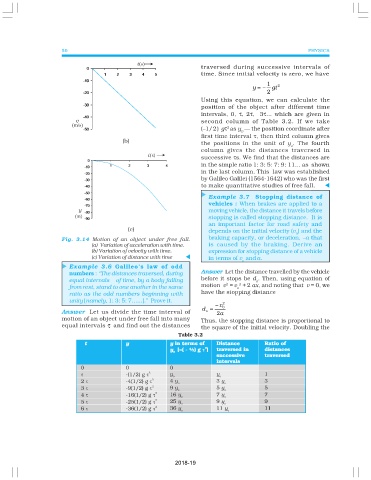
                                                                        traversed during successive intervals of
                                                                        time. Since initial velocity is zero, we have
                                                                                                1
                                                                                          y = −  gt  2
                                                                                                2
                                                                        Using this equation, we can calculate the
                                                                        position of the object after different time
                                                                        intervals, 0, τ, 2τ,  3τ… which are given in
                                                                        second column of Table 3.2. If we take
                                                                                 2
                                                                        (–1/2)  gτ as y — the position coordinate after
                                                                                      0
                                                                        first time interval τ, then third column gives
                                            (b)
                                                                        the positions in the unit of   y . The fourth
                                                                                                        o
                                                                        column gives the distances traversed in
                                                                        successive τs. We find that the distances are
                                                                        in the simple ratio 1: 3: 5: 7: 9: 11… as  shown
                                                                        in the last column. This  law was established
                                                                        by Galileo Galilei (1564-1642) who was the first
                                                                        to make quantitative studies of free fall.  t

                                                                           Example 3.7     Stopping distance of
                                                                          t
                                                                           vehicles : When brakes are applied to a
                                                                           moving vehicle, the distance it travels before
                                                                           stopping is called stopping distance.  It is
                                                                           an important factor for road safety and
                                                 (c)                       depends on the initial velocity (v ) and the
                                                                                                          0
                       Fig. 3.14  Motion of an object under free fall.     braking capacity, or deceleration, –a that
                                 (a)  Variation of acceleration with time.  is caused by the braking. Derive an
                                 (b) Variation of velocity with time.      expression for stopping distance of a vehicle
                                 (c) Variation of distance with time  t    in terms of v  anda.
                                                                                       o
                          Example 3.6     Galileo’s law of odd
                         t
                          numbers : “The distances traversed, during    Answer  Let the distance travelled by the vehicle
                          equal intervals    of time, by a body falling  before it stops be d . Then, using equation of
                                                                                            s
                                                                                 2
                                                                                      2
                          from rest, stand to one another in the same   motion  v  = v  + 2 ax, and noting that  v = 0, we
                                                                                     o
                          ratio as the odd numbers beginning with       have the stopping distance
                          unity [namely, 1: 3: 5: 7…...].”  Prove it.           2
                                                                             – v
                                                                         d =    0
                       Answer  Let us divide the time interval of         s   2 a
                       motion of an object under free fall into many    Thus, the stopping distance is proportional to

                       equal intervals τ   and find out the distances   the square of the initial velocity. Doubling the
                                                                Table 3.2


                                                               2018-19

