


Page 75 - Class-11-Physics-Part-1_Neat
P. 75
MOTION IN A STRAIGHT LINE 61
APPENDIX 3.1 : ELEMENTS OF CALCULUS
Differential Calculus
Using the concept of ‘differential coefficient’ or ‘derivative’, we can easily define velocity and
acceleration. Though you will learn in detail in mathematics about derivatives, we shall introduce
this concept in brief in this Appendix so as to facilitate its use in describing physical quantities
involved in motion.
Suppose we have a quantity y whose value depends upon a single variable x, and is expressed
by an equation defining y as some specific function of x. This is represented as:
y = f (x) (1)
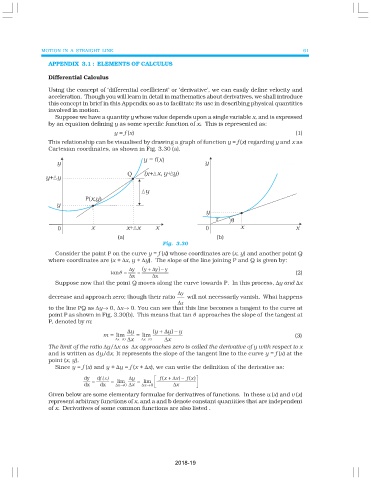
This relationship can be visualised by drawing a graph of function y = f (x) regarding y and x as
Cartesian coordinates, as shown in Fig. 3.30 (a).
(a) (b)
Fig. 3.30
Consider the point P on the curve y = f (x) whose coordinates are (x, y) and another point Q
where coordinates are (x + ∆x, y + ∆y). The slope of the line joining P and Q is given by:
∆ y (y + ∆ y ) y
−
θ
tan = = (2)
∆ x ∆ x
Suppose now that the point Q moves along the curve towards P. In this process, ∆y and ∆x
∆y
decrease and approach zero; though their ratio will not necessarily vanish. What happens
∆x
to the line PQ as ∆y→ 0, ∆x→ 0. You can see that this line becomes a tangent to the curve at
point P as shown in Fig. 3.30(b). This means that tan θ approaches the slope of the tangent at
P, denoted by m:
∆ y (y + ∆ ) y − y
m = lim = lim (3)
∆ x→ ∆ ∆ x → 0 ∆ x
0 x
The limit of the ratio ∆y/∆x as ∆x approaches zero is called the derivative of y with respect to x
and is written as dy/dx. It represents the slope of the tangent line to the curve y = f (x) at the
point (x, y).
Since y = f (x) and y + ∆y = f (x + ∆x), we can write the definition of the derivative as:
)
dy df ( ) x ∆y f ( x + ∆x – f x ( )
= = lim = lim
dx dx ∆x →0 ∆x ∆x →0 ∆x
Given below are some elementary formulae for derivatives of functions. In these u (x) and v (x)
represent arbitrary functions of x, and a and b denote constant quantities that are independent
of x. Derivatives of some common functions are also listed .
2018-19

