


Page 76 - Class-11-Physics-Part-1_Neat
P. 76
62                                                                                     PHYSICS

                                         d  (a   u)  d u               du    du   dx
                                             =  a                 ;        =     .
                                         x d     x d                    dt    dx  dt
                                                                         ( /v
                                      d( uv)    v d   d u              d u    )  =  1 du    dv
                                            = u   +  v            ;                2    – u
                                         x d    x d    x d                dx     v  dx      dx


                                       u d  u d  x d
                                         =
                                       v d   v d  x d

                                      d                                 d
                                                                                )
                                        (sin  ) x    =  cos  x    ;        (cos x =  – sin x
                                       x d                             dx
                                      d                                 d
                                         (tan ) x =  sec x        ;       (cot ) =  – cosec  2   x
                                                    2
                                                                             x
                                      dx                               dx
                                       d

                                          (sec   x) =  tan     x sec  x    ;  d  (cosec x =  – cot     co sec x
                                                                               2
                                                                                        x
                                                                                 )
                                        x   d                          dx
                                      d  ( u) =  u   n  n 1  d u  ;     d  ( ln u) =  1
                                           n
                                                  –
                                      d x           d x                du         u
                                      d
                                          u
                                         (e ) =  e u
                                      du
                       In terms of derivatives, instantaneous velocity and acceleration are defined as
                                                    ∆ x  d x
                                             v =  lim     =
                                                ∆ t→ 0  t ∆  t d
                                                     ∆ v  dv   d x
                                                                2
                                             a =  lim    =   =
                                                 t ∆ → 0 ∆ t  dt  dt  2
                       Integral Calculus
                       You are familiar with the notion of area.  The formulae for areas of simple geometrical figures are
                       also known to you.  For example, the area of a rectangle is length times breadth and that of a
                       triangle is half of the product of base and height.  But how to deal with the problem of determination
                       of area of an irregular figure?  The mathematical notion of integral is necessary in connection with
                       such problems.
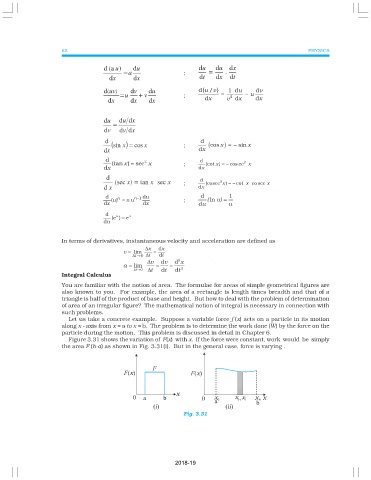
                         Let us take a concrete example.  Suppose a variable force f (x) acts on a particle in its motion
                       along x - axis from x = a to x = b.  The problem is to determine the work done (W) by the force on the
                       particle during the motion.  This problem is discussed in detail in Chapter 6.
                         Figure 3.31 shows the variation of  F(x)  with x.  If the force were constant, work  would  be  simply
                       the area F (b-a) as shown in Fig. 3.31(i).  But in the general case, force is varying .


                                                                  Fig. 3.31


                                                               2018-19

