


Page 80 - Class-11-Physics-Part-1_Neat
P. 80
66                                                                                     PHYSICS

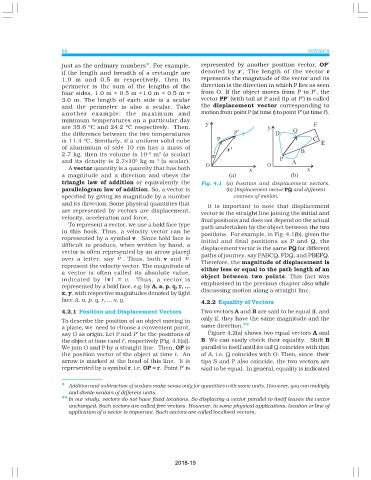
                       just as the ordinary numbers*. For example,      represented by another position vector, OP′
                       if the length and breadth of a rectangle are     denoted by r′. The length of the vector r
                       1.0 m and 0.5 m       respectively, then its     represents the magnitude of the vector and its
                       perimeter is the sum of the lengths of the       direction is the direction in which P lies as seen
                       four sides, 1.0 m + 0.5 m +1.0 m + 0.5 m =       from O. If the object moves from P to P′, the
                       3.0 m. The length of each side is a scalar       vector PP′ (with tail at P and tip at P′) is called
                       and the perimeter is also a scalar. Take         the displacement vector corresponding to
                       another    example:    the  maximum      and     motion from point P (at time t) to point P′ (at time t′).
                       minimum temperatures on a particular day
                       are 35.6 °C and 24.2 °C respectively.  Then,
                       the difference between the two temperatures
                       is 11.4 °C. Similarly, if a uniform solid cube
                       of aluminium of side 10 cm has a mass of
                                                         3
                                                     –3
                       2.7 kg, then its volume is 10  m  (a scalar)
                                                 3
                                                        –3
                       and its density is 2.7×10  kg m  (a scalar).
                         A vector quantity is a quantity that has both
                       a magnitude and a direction and obeys the
                       triangle law of addition  or equivalently the    Fig. 4.1 (a)  Position and displacement vectors.
                       parallelogram law of addition. So, a vector is            (b) Displacement vector PQ and different
                       specified by giving its magnitude by a number                  courses of motion.
                       and its direction. Some physical quantities that
                                                                           It is important to note that displacement
                       are represented by vectors are displacement,     vector is the straight line joining the initial and
                       velocity, acceleration and force.
                                                                        final positions and does not depend on the actual
                         To represent a vector, we use a bold face type  path undertaken by the object between the two
                       in this book. Thus, a velocity vector can be
                                                                        positions.  For example, in Fig. 4.1(b), given the
                       represented by a symbol v.  Since bold face is
                                                                        initial and final positions as P and Q, the
                       difficult to produce, when written by hand, a    displacement vector is the same PQ for different
                       vector is often represented by an arrow placed
                                           r
                                                                   r
                       over a letter, say v . Thus, both v and v        paths of journey, say PABCQ, PDQ, and PBEFQ.
                                                                        Therefore, the magnitude of displacement is
                       represent the velocity vector. The magnitude of
                                                                        either less or equal to the path length of an
                       a vector is often called its absolute value,
                                                                        object between two points.      This fact was
                       indicated by |v| = v.     Thus, a vector is      emphasised in the previous chapter also while
                       represented by a bold face, e.g. by A, a, p, q, r, ...
                                                                        discussing motion along a straight line.
                       x, y, with respective magnitudes denoted by light
                       face A, a, p, q, r, ... x, y.                    4.2.2  Equality of Vectors
                       4.2.1  Position and Displacement Vectors         Two vectors A and B are said to be equal if, and
                                                                        only if, they have the same magnitude and the
                       To describe the position of an object moving in
                       a plane, we  need to choose a convenient point,  same direction.**
                       say O as origin. Let P and P′ be the positions of   Figure 4.2(a) shows two equal vectors A and
                       the object at time t and t′, respectively [Fig. 4.1(a)].  B. We can easily check their equality.  Shift B
                       We join O and P by a straight line.  Then, OP is  parallel to itself until its tail Q coincides with that
                       the position vector of the object at time t.  An  of A, i.e. Q coincides with O. Then, since  their
                       arrow is marked at the head of this line.  It is  tips S and P also coincide, the two vectors are
                       represented by a symbol r, i.e. OP = r.  Point P′ is  said to be equal.  In general, equality is indicated


                       * Addition and subtraction of scalars make sense only for quantities with same units. However, you can multiply
                         and divide scalars of different units.
                       ** In our study, vectors do not have fixed locations. So displacing a vector parallel to itself leaves the vector
                         unchanged. Such vectors are called free vectors. However, in some physical applications, location or line of
                         application of a vector is important. Such vectors are called localised vectors.


                                                               2018-19

