


Page 19 - Lords of Madness: The Book of Aberrations
P. 19
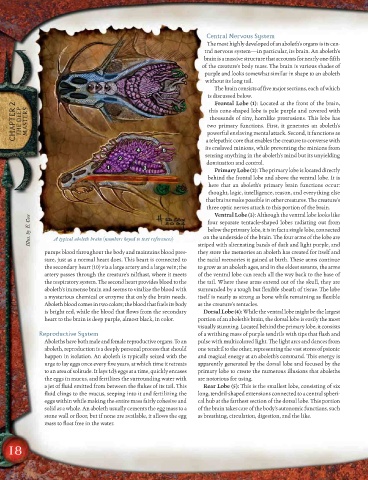
Central Nervous System
                                                                    The most highly developed of an aboleth’s organs is its cen-
                                                                   tral nervous system—in particular, its brain. An aboleth’s
                                                                   brain is a massive structure that accounts for nearly one-fifth

                                                                  of the creature’s body mass. The brain is various shades of
                                                                   purple and looks somewhat similar in shape to an aboleth
                                                                   without its long tail.

                                                                       The brain consists of five major sections, each of which
                                                                    is discussed below.
                                                                      Frontal Lobe (1): Located at the front of the brain,
      CHAPTER 2  THE DEEP   MASTERS                                 two  primary  functions.  First,  it  generates  an  aboleth’s
                                                                     this cone-shaped lobe is pale purple and covered with
                                                                     thousands of tiny, hornlike protrusions. This lobe has

                                                                    powerful enslaving mental attack. Second, it functions as
                                                                    a telepathic core that enables the creature to converse with
                                                                   its enslaved minions, while preventing the minions from

                                                                   sensing anything in the aboleth’s mind but its unyielding
                                                                    domination and control.
                                                                      Primary Lobe (2): The primary lobe is located directly
                                                                    behind the frontal lobe and above the ventral lobe. It is
                                                                    here  that  an  aboleth’s  primary  brain  functions  occur:
                                                                    thought, logic, intelligence, reason, and everything else
                                                                    that brains make possible in other creatures. The creature’s
                                                                    three optic nerves attach to this portion of the brain.
                                                                      Ventral Lobe (3): Although the ventral lobe looks like
           Illus. by E. Cox  A typical aboleth brain (numbers keyed to text references)  on the underside of the brain. The four arms of the lobe are
                                                                    four  separate  tentacle-shaped  lobes  radiating  out  from
                                                                    below the primary lobe, it is in fact a single lobe, connected


                                                                 they store the memories an aboleth has created for itself and
               pumps blood throughout the body and maintains blood pres-  striped with alternating bands of dark and light purple, and
               sure, just as a normal heart does. This heart is connected to   the racial memories it gained at birth. These arms continue
               the secondary heart (10) via a large artery and a large vein; the   to grow as an aboleth ages, and in the eldest savants, the arms
               artery passes through the creature’s nilthast, where it meets   of the ventral lobe can reach all the way back to the base of
               the respiratory system. The second heart provides blood to the   the tail. Where these arms extend out of the skull, they are

               aboleth’s immense brain and seems to vitalize the blood with   surrounded by a tough but flexible sheath of tissue. The lobe

               a mysterious chemical or enzyme that only the brain needs.   itself is nearly as strong as bone while remaining as flexible
               Aboleth blood comes in two colors; the blood that fuels its body   as the creature’s tentacles.

               is bright red, while the blood that flows from the secondary   Dorsal Lobe (4): While the ventral lobe might be the largest
               heart to the brain is deep purple, almost black, in color.  portion of an aboleth’s brain, the dorsal lobe is easily the most
                                                                 visually stunning. Located behind the primary lobe, it consists
              Reproductive System                                of a writhing mass of purple tendrils with tips that flash and

               Aboleths have both male and female reproductive organs. To an   pulse with multicolored light. The light arcs and dances from
               aboleth, reproduction is a deeply personal process that should   one tendril to the other, representing the vast stores of psionic
               happen in isolation. An aboleth is typically seized with the   and magical energy at an aboleth’s command. This energy is
               urge to lay eggs once every five years, at which time it retreats   apparently generated by the dorsal lobe and focused by the

               to an area of solitude. It lays 1d3 eggs at a time, quickly encases   primary lobe to create the numerous illusions that aboleths
               the eggs in mucus, and fertilizes the surrounding water with   are notorious for using.
               a jet of fluid emitted from between the flukes of its tail. This   Rear Lobe (5): This is the smallest lobe, consisting of six


               fluid clings to the mucus, seeping into it and fertilizing the   long, tendril-shaped extensions connected to a central spheri-
               eggs within while making the entire mass fairly cohesive and   cal hub at the farthest section of the dorsal lobe. This portion
               solid as a whole. An aboleth usually cements the egg mass to a   of the brain takes care of the body’s autonomic functions, such

               stone wall or floor, but if none are available, it allows the egg   as breathing, circulation, digestion, and the like.

               mass to float free in the water.

   18

