


Page 44 - The Atlas of Economic Complexity
P. 44
MAPPING PATHS TO PROSPERITY  |  45


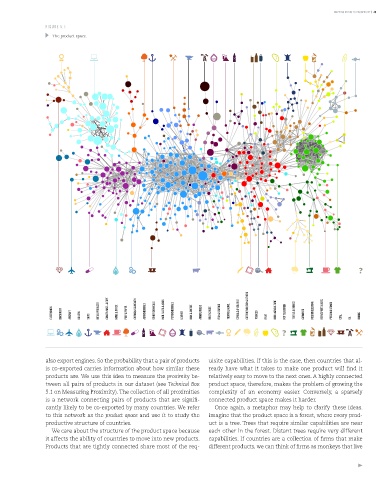
                  FIGURE 5.1:
                     The product space.


                    ELECTRONICS  MACHINERY  AIRCRAFT   bOILERS   SHIPS   METAL PRODUCTS  CONSTR. MATL. & EqPT.  HOME & OFFICE  PULP & PAPER  CHEMICALS & HEALTH  AGROCHEMICALS  OTHER CHEMICALS  INOR. SALTS & ACIDS  PETROCHEMICALS  LEATHER  MILK & CHEESE  ANIMAL FIbERS  MEAT & EGGS  FISH & SEAFOOD  TROPICAL AGRIC.  CEREALS & vEG. OILS  COTTON/RICE/SOY & OTHERS  TObACCO  FRUIT  MISC. AGRICULTURE  NOT CLASSIFIED  TEXTILE & FAbRICS  GARMENTS  FOOD PROCESSING  bEER/SPIRITS & CIGS.  PRECIOUS STONES  COAL  OIL  MINING


                  also export engines. So the probability that a pair of products   uisite capabilities. If this is the case, then countries that al-
                  is co-exported carries information about how similar these   ready have what it takes to make one product will find it
                  products are. We use this idea to measure the proximity be-  relatively easy to move to the next ones. A highly connected
                  tween all pairs of products in our dataset (see Technical Box   product space, therefore, makes the problem of growing the
                  5.1 on Measuring Proximity). The collection of all proximities   complexity  of  an  economy  easier.  Conversely,  a  sparsely
                  is  a  network  connecting  pairs  of  products  that  are  signifi-  connected product space makes it harder.
                  cantly likely to be co-exported by many countries. We refer    Once again, a metaphor may help to clarify these ideas.
                  to this network as the product space and use it to study the   Imagine that the product space is a forest, where every prod-
                  productive structure of countries.                           uct is a tree. Trees that require similar capabilities are near
                    We care about the structure of the product space because   each other in the forest. Distant trees require very different
                  it affects the ability of countries to move into new products.   capabilities. If countries are a collection of firms that make
                  Products that are tightly connected share most of the req-   different products, we can think of firms as monkeys that live

