


Page 45 - The Atlas of Economic Complexity
P. 45
46  |  THE ATLAS OF ECONOMIC COMPLEXITY


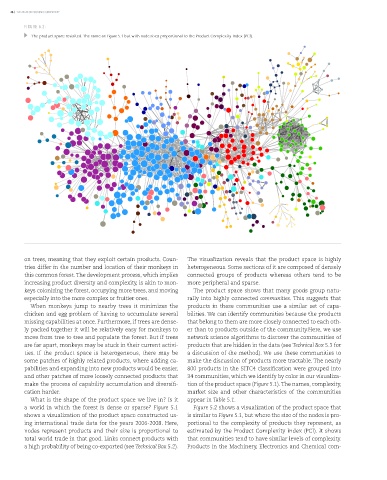
          FIGURE 5.2:
             The product space revisited. The same as Figure 5.1 but with node sizes proportional to the Product Complexity Index (PCI).


          on trees, meaning that they exploit certain products. Coun-  The visualization reveals that the product space is highly
          tries differ in the number and location of their monkeys in   heterogeneous. Some sections of it are composed of densely
          this common forest. The development process, which implies   connected  groups  of  products  whereas  others  tend  to  be
          increasing product diversity and complexity, is akin to mon-  more peripheral and sparse.
          keys colonizing the forest, occupying more trees, and moving   The product space shows that many goods group natu-
          especially into the more complex or fruitier ones.           rally into highly connected communities. This suggests that
            When  monkeys  jump  to  nearby  trees  it  minimizes  the   products  in  these  communities  use  a  similar  set  of  capa-
          chicken and egg problem of having to accumulate several      bilities. We can identify communities because the products
          missing capabilities at once. Furthermore, if trees are dense-  that belong to them are more closely connected to each oth-
          ly packed together it will be relatively easy for monkeys to   er than to products outside of the community.Here, we use
          move from tree to tree and populate the forest. But if trees   network science algorithms to discover the communities of
          are far apart, monkeys may be stuck in their current activi-  products that are hidden in the data (see Technical Box 5.3 for
          ties.  If  the  product  space  is  heterogeneous,  there  may  be   a discussion of the method). We use these communities to
          some patches of highly related products, where adding ca-    make the discussion of products more tractable. The nearly
          pabilities and expanding into new products would be easier,   800 products in the SITC4 classification were grouped into
          and other patches of more loosely connected products that    34 communities, which we identify by color in our visualiza-
          make the process of capability accumulation and diversifi-   tion of the product space (Figure 5.1). The names, complexity,
          cation harder.                                               market  size  and  other  characteristics  of  the  communities
            What is the shape of the product space we live in? Is it   appear in Table 5.1.
          a  world  in  which  the  forest  is  dense  or  sparse?  Figure  5.1   Figure 5.2 shows a visualization of the product space that
          shows a visualization of the product space constructed us-   is similar to Figure 5.1, but where the size of the nodes is pro-
          ing international trade data for the years 2006-2008. Here,   portional to the complexity of products they represent, as
          nodes represent products and their size is proportional to   estimated by the Product Complexity Index (PCI). It shows
          total world trade in that good. Links connect products with   that communities tend to have similar levels of complexity.
          a high probability of being co-exported (see Technical Box 5.2).   Products in the Machinery, Electronics and Chemical com-

