


Page 46 - The Atlas of Economic Complexity
P. 46
MAPPING PATHS TO PROSPERITY  |  47


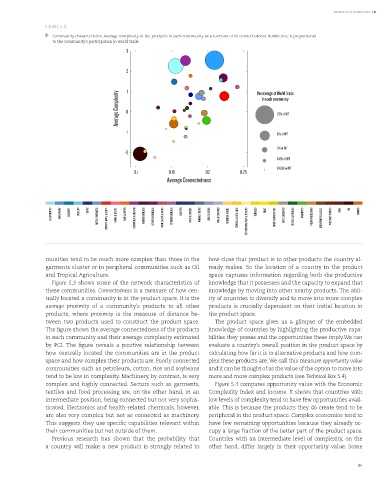
                  FIGURE 5.3:
                     Community characteristics. Average complexity of the products in each community as a function of its connectedness. Bubble size is proportional
                     to the community’s participation in world trade.
                                                3


                                                2


                                             Average Complexity  0 1                             Percentage of World Trade
                                                                                                  in each community


                                                                                                        22% of WT


                                                -1                                                      6% of WT


                                                                                                        2% of WT
                                                -2
                                                                                                        0.8% of WT

                                                                                                        0.06% of WT
                                                   0.1          0.15          0.2         0.25
                                                               Average Connectedness


                    ELECTRONICS  MACHINERY  AIRCRAFT   bOILERS   SHIPS   METAL PRODUCTS  CONSTR. MATL. & EqPT.  HOME & OFFICE  PULP & PAPER  CHEMICALS & HEALTH  AGROCHEMICALS  OTHER CHEMICALS  INOR. SALTS & ACIDS  PETROCHEMICALS  LEATHER  MILK & CHEESE  ANIMAL FIbERS  MEAT & EGGS  FISH & SEAFOOD  TROPICAL AGRIC.  CEREALS & vEG. OILS  COTTON/RICE/SOY & OTHERS  TObACCO  FRUIT  MISC. AGRICULTURE  NOT CLASSIFIED  TEXTILE & FAbRICS  GARMENTS  FOOD PROCESSING  bEER/SPIRITS & CIGS.  PRECIOUS STONES  COAL  OIL  MINING


                  munities tend to be much more complex than those in the      how close that product is to other products the country al-
                  garments cluster or in peripheral communities such as Oil    ready  makes.  So  the  location  of  a  country  in  the  product
                  and Tropical Agriculture.                                    space captures information regarding both the productive
                    Figure  5.3  shows  some  of  the  network  characteristics  of   knowledge that it possesses and the capacity to expand that
                  these communities. Connectedness is a measure of how cen-    knowledge by moving into other nearby products. The abil-
                  trally located a community is in the product space. It is the   ity of countries to diversify and to move into more complex
                  average  proximity  of  a  community’s  products  to  all  other   products is crucially dependent on their initial location in
                  products,  where  proximity  is  the  measure  of  distance  be-  the product space.
                  tween  two  products  used  to  construct  the  product  space.   The  product  space  gives  us  a  glimpse  of  the  embedded
                  The figure shows the average connectedness of the products   knowledge of countries by highlighting the productive capa-
                  in each community and their average complexity estimated     bilities they posses and the opportunities these imply.We can
                  by  PCI.  The  figure  reveals  a  positive  relationship  between   evaluate a country’s overall position in the product space by
                  how centrally located the communities are in the product     calculating how far it is to alternative products and how com-
                  space and how complex their products are. Poorly connected   plex these products are. We call this measure opportunity value
                  communities such as petroleum, cotton, rice and soybeans     and it can be thought of as the value of the option to move into
                  tend to be low in complexity. Machinery, by contrast, is very   more and more complex products (see Technical Box 5.4).
                  complex and highly connected. Sectors such as garments,        Figure 5.4 compares opportunity value with the Economic
                  textiles and food processing are, on the other hand, in an   Complexity Index and income. It shows that countries with
                  intermediate position, being connected but not very sophis-  low levels of complexity tend to have few opportunities avail-
                  ticated. Electronics and health-related chemicals, however,   able. This is because the products they do create tend to be
                  are also very complex but not as connected as machinery.     peripheral in the product space. Complex economies tend to
                  This suggests they use specific capabilities relevant within   have few remaining opportunities because they already oc-
                  their communities but not outside of them.                   cupy a large fraction of the better part of the product space.
                    Previous  research  has  shown  that  the  probability  that   Countries with an intermediate level of complexity, on the
                  a  country  will  make  a  new  product  is  strongly  related  to   other  hand,  differ  largely  in  their  opportunity  value.  Some

