


Page 76 - Engineering Mathematics Workbook_Final
P. 76
Vector Calculus
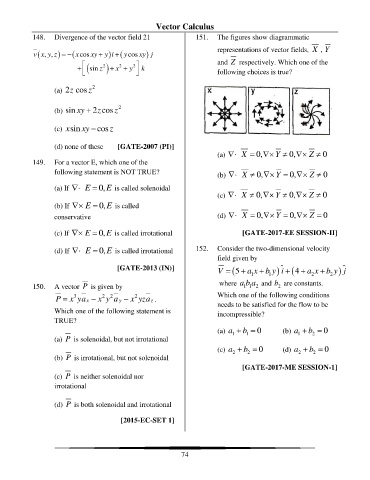
148. Divergence of the vector field 21 151. The figures show diagrammatic
)
v ( , ,x y z = − ( cosx xy + y ) ( cosi + y xy ) j representations of vector fields, X , Y
2 and Z respectively. Which one of the
+ ( sin z 2 ) x+ 2 + y k
following choices is true?
2
(a) 2 cosz z
2
z
(b) sin xy + 2 cos z
x
(c) sin xy − cosz
(d) none of these [GATE-2007 (PI)]
(a) X = 0, Y 0, Z 0
149. For a vector E, which one of the
following statement is NOT TRUE? X 0, Y = 0, Z
(b) 0
(a) If E = 0,E is called solenoidal
(c) X 0, Y 0, Z 0
(b) If E = 0,E is called
conservative (d) X = 0, Y = 0, Z = 0
(c) If E = 0,E is called irrotational [GATE-2017-EE SESSION-II]
(d) If E = 0,E is called irrotational 152. Consider the two-dimensional velocity
field given by
$
[GATE-2013 (IN)] V = (5 a x b y i+ 1 + 1 ) + (4 a x b y j+ 2 + 2 ) $
where a b a and b are constants.
150. A vector P is given by 1 1 2 2
2
P = x ya x − x y 2 y a − x yza z . Which one of the following conditions
3
2
needs to be satisfied for the flow to be
Which one of the following statement is incompressible?
TRUE?
(a) a + 1 b = 1 0 (b) a + 1 b = 2 0
(a) P is solenoidal, but not irrotational
(c) a + 2 b = 2 0 (d) a + 2 b = 2 0
(b) P is irrotational, but not solenoidal
[GATE-2017-ME SESSION-1]
(c) P is neither solenoidal nor
irrotational
(d) P is both solenoidal and irrotational
[2015-EC-SET 1]
74

