


Page 17 - DK Children's Encyclopedia
P. 17
Amphibians                                                                        SEE ALSO

                                                                                               ▸ ▸ Eggs  p.86
                                                                                              ▸ ▸ Water  pp.120–121
           Amphibians are animals that spend their lives in and                                ▸ ▸ Invertebrates
           around water. They hatch in water from eggs. As they                                 p.139
           grow they develop lungs that let them breathe on land.                              ▸ ▸ Metamorphosis

           Amphibian skin must always be wet, so they stay close                                p.163
           to water. There are three main groups of amphibian.                                 ▸ ▸ Reptiles  p.210
                                                                                               ▸ ▸ Skin  p.229


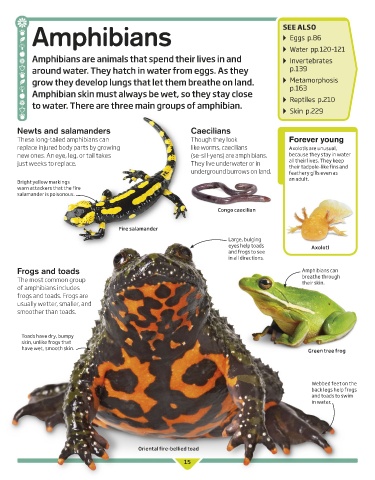
       Newts and salamanders                                   Caecilians
       These long-tailed amphibians can                        Though they look                Forever young
       replace injured body parts by growing                   like worms, caecilians          Axolotls are unusual,
       new ones. An eye, leg, or tail takes                    (se-sill-yens) are amphibians.   because they stay in water
       just weeks to replace.                                  They live underwater or in      all their lives. They keep
                                                                                               their tadpole-like fins and
                                                               underground burrows on land.    feathery gills even as
       Bright yellow markings                                                                  an adult.
       warn attackers that the fire
       salamander is poisonous.

                                                                        Congo caecilian


                                        Fire salamander
                                                                            Large, bulging
                                                                            eyes help toads            Axolotl
                                                                            and frogs to see
                                                                            in all directions.
       Frogs and toads                                                                              Amphibians can
       The most common group                                                                        breathe through
                                                                                                    their skin.
       of amphibians includes
       frogs and toads. Frogs are
       usually wetter, smaller, and
       smoother than toads.


        Toads have dry, bumpy
        skin, unlike frogs that
        have wet, smooth skin.                                                                        Green tree frog


                                                                                                       Webbed feet on the
                                                                                                       back legs help frogs
                                                                                                       and toads to swim
                                                                                                       in water.


                                              Oriental fire-bellied toad
                                                             15


   US_015_Amphibians.indd   15                                                                                   16/05/2017   09:45

