


Page 84 - DK Children's Encyclopedia
P. 84
Early humans                                                                      SEE ALSO

                                                                                               ▸ ▸ Africa  p.12
                                                                                               ▸ ▸ Evolution  p.95
           The first humans were similar to apes, such as gorillas and                         ▸ ▸ Fossils  p.111
           chimpanzees. Over millions of years, they learned to walk                           ▸ ▸ Monkeys
           on two legs and got smarter as their brains grew larger.                             and apes  p.170

           They also lost most of their body hair, slowly becoming                             ▸ ▸ Exploration
           more like the humans we are today.                                                   pp.180–181
                                                                                               ▸ ▸ Stone Age  p.243


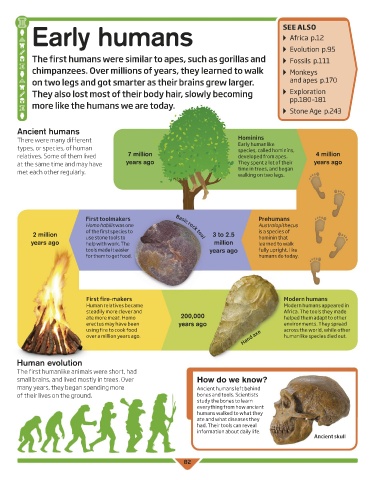
       Ancient humans
       There were many different                                               Hominins
       types, or species, of human                                             Early humanlike
                                                                               species, called hominins,
       relatives. Some of them lived       7 million                           developed from apes.     4 million
       at the same time and may have      years ago                            They spent a lot of their   years ago
       met each other regularly.                                               time in trees, and began
                                                                               walking on two legs.


                             First toolmakers                                        Prehumans
                             Homo habilis was one         Basic rock tool            Australopithecus
                             of the first species to                                 is a species of
            2 million        use stone tools to                       3 to 2.5       hominin that
           years ago         help with work. The                       million       learned to walk
                             tools made it easier                    years ago       fully upright, like
                             for them to get food.                                   humans do today.


                             First fire-makers                                                Modern humans
                             Human relatives became                                           Modern humans appeared in
                             steadily more clever and                                         Africa. The tools they made
                             ate more meat. Homo            200,000                           helped them adapt to other
                             erectus may have been         years ago                          environments. They spread
                             using fire to cook food                                          across the world, while other
                             over a million years ago.                          Hand axe      humanlike species died out.


       Human evolution
       The first humanlike animals were short, had
       small brains, and lived mostly in trees. Over             How do we know?
       many years, they began spending more                      Ancient humans left behind
       of their lives on the ground.                             bones and tools. Scientists
                                                                 study the bones to learn
                                                                 everything from how ancient
                                                                 humans walked to what they
                                                                 ate and what diseases they
                                                                 had. Their tools can reveal
                                                                 information about daily life.
                                                                                                        Ancient skull


                                                             82


   US_082_Early_Humans.indd   82                                                                                 16/05/2017   09:47

