


Page 11 - St Giles Catesby booklet MC StG 20210723 e-flip_Neat
P. 11
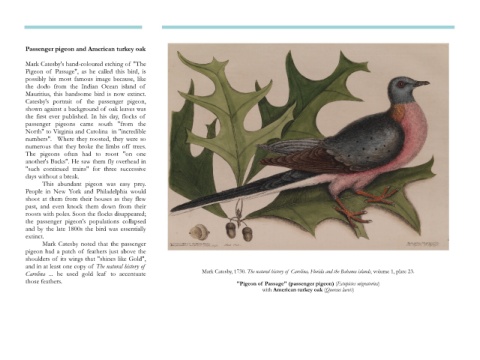
Passenger pigeon and American turkey oak

            Mark Catesby's hand-coloured etching of "The
            Pigeon  of  Passage",  as  he  called  this  bird,  is
            possibly  his  most  famous  image  because,  like
            the  dodo  from  the  Indian  Ocean  island  of
            Mauritius,  this  handsome  bird  is  now  extinct.
            Catesby's  portrait  of  the  passenger  pigeon,
            shown against a background of oak leaves was
            the  first  ever  published.  In  his  day,  flocks  of
            passenger  pigeons  came  south  "from  the
            North" to Virginia and Carolina  in "incredible
            numbers".   Where they roosted, they were so
            numerous that they broke the limbs off trees.
            The  pigeons  often  had  to  roost  "on  one
            another's Backs". He saw them fly overhead in
            "such  continued  trains"  for  three  successive
            days without a break.
                   This  abundant  pigeon  was  easy  prey.
            People  in  New  York  and  Philadelphia  would
            shoot at them from their houses as they flew
            past,  and  even  knock  them  down  from  their
            roosts with poles. Soon the flocks disappeared;
            the  passenger  pigeon's  populations  collapsed
            and by the late 1800s the bird was essentially
            extinct.
                   Mark Catesby noted that the passenger
            pigeon had a patch of feathers just above the
            shoulders of its wings that "shines like Gold",
            and in at least one copy of The natural history of
            Carolina  ...  he  used  gold  leaf  to  accentuate                        Mark Catesby, 1730. The natural history of  Carolina, Florida and the Bahama islands, volume 1, plate 23.
            those feathers.                                                                           "Pigeon of  Passage" (passenger pigeon) (Ectopictes migratorius)
                                                                                                                 with American turkey oak (Quercus laevis)

