


Page 15 - St Giles Catesby booklet MC StG 20210723 e-flip_Neat
P. 15
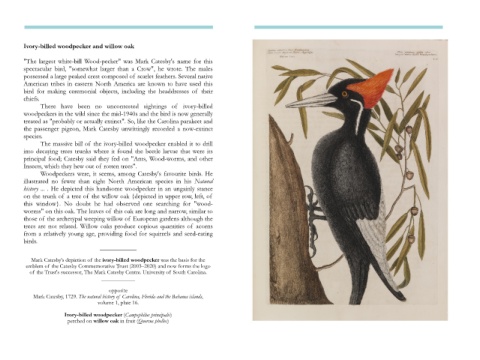
Ivory-billed woodpecker and willow oak


           "The largest white-bill Wood-pecker" was Mark Catesby's name for this
           spectacular  bird,  "somewhat  larger  than  a  Crow",  he  wrote.  The  males
           possessed a large peaked crest composed of scarlet feathers. Several native
           American tribes in eastern North America are known to have used this
           bird  for  making  ceremonial  objects,  including  the  headdresses  of  their
           chiefs.
                  There  have  been  no  uncontested  sightings  of  ivory-billed
           woodpeckers in the wild since the mid-1940s and the bird is now generally
           treated as "probably or actually extinct". So, like the Carolina parakeet and
           the passenger pigeon, Mark Catesby unwittingly recorded a now-extinct
           species.
                  The massive bill of the ivory-billed woodpecker enabled it to drill
           into decaying trees trunks where it found the beetle larvae that were its
           principal food; Catesby said they fed on "Ants, Wood-worms, and other
           Insects, which they hew out of rotten trees".
                  Woodpeckers were, it seems, among Catesby's favourite birds. He
           illustrated  no  fewer  than  eight  North  American  species  in  his  Natural
           history ... . He depicted this handsome woodpecker in an ungainly stance
           on the trunk of a tree of the willow oak {depicted in upper row, left, of
           this  window}.  No  doubt  he  had  observed  one  searching  for  "wood-
           worms" on this oak. The leaves of this oak are long and narrow, similar to
           those of the archetypal weeping willow of European gardens although the
           trees are not related. Willow oaks produce copious quantities of acorns
           from a relatively young age, providing food for squirrels and seed-eating
           birds.
                                            _____________

              Mark Catesby's depiction of the ivory-billed woodpecker was the basis for the
            emblem of the Catesby Commemorative Trust (2003–2020) and now forms the logo
              of the Trust's successor, The Mark Catesby Centre. University of South Carolina.
                                            ____________


                                               opposite
               Mark Catesby, 1729. The natural history of  Carolina, Florida and the Bahama islands,
                                           volume 1, plate 16.

                            Ivory-billed woodpecker (Campephilus principalis)
                              perched on willow oak in fruit (Quercus phellos)

