


Page 13 - St Giles Catesby booklet MC StG 20210723 e-flip_Neat
P. 13
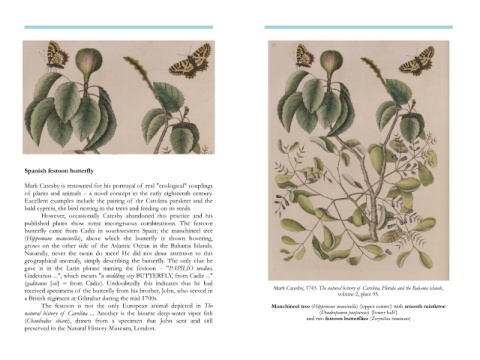
Spanish festoon butterfly


           Mark Catesby is renowned for his portrayal of real "ecological" couplings
           of plants and animals – a novel concept in the early eighteenth century.
           Excellent examples include the pairing of the Carolina parakeet and the
           bald cypress, the bird nesting in the trees and feeding on its seeds.
                   However,  occasionally  Catesby  abandoned  this  practice  and  his
           published  plates  show  some  incongruous  combinations.  The  festoon
           butterfly  came  from  Cadiz  in  southwestern  Spain;  the  manchineel  tree
           (Hippomane  mancinella),  above  which  the  butterfly  is  shown  hovering,
           grows  on  the  other  side  of  the  Atlantic  Ocean  in  the  Bahama  Islands.
           Naturally,  never  the  twain  do  meet!  He  did  not  draw  attention  to  this
           geographical anomaly, simply describing the butterfly. The only clue he
           gave  is  in  the  Latin  phrase  naming  the  festoon  –  "PAPILIO  medius,
           Gadetanus ...", which means "a middling size BUTTERFLY, from Cadiz ..."
           (gaditanus  [sic] =  from  Cadiz).  Undoubtedly  this  indicates  that  he  had
           received specimens of the butterfly from his brother, John, who served in                                  Mark Catesby, 1743. The natural history of  Carolina, Florida and the Bahama islands,
                                                                                                                                                 volume 2, plate 95.
           a British regiment at Gibraltar during the mid-1700s.
                   The  festoon  is  not  the  only  European  animal  depicted  in  The                             Manchineel tree (Hippomane mancinella) {upper centre} with smooth mistletoe
           natural history of  Carolina ... Another is the bizarre deep-water viper fish                                                 (Dendropemon purpureus) {lower half}
           (Chauliodus  sloani),  drawn  from  a  specimen  that  John  sent  and  still                                            and two festoon butterflies (Zerynthia ruminans)
           preserved in the Natural History Museum, London.

