


Page 12 - St Giles Catesby booklet MC StG 20210723 e-flip_Neat
P. 12
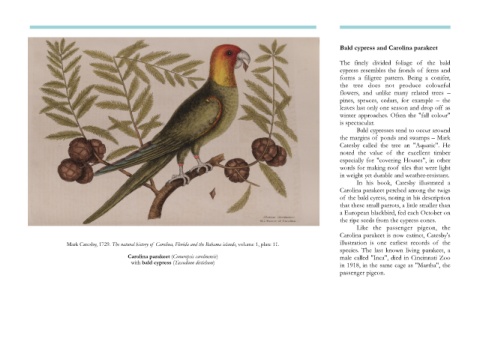
Bald cypress and Carolina parakeet


                                                                                                                                                  The  finely  divided  foliage  of  the  bald
                                                                                                                                                  cypress resembles the fronds of ferns and
                                                                                                                                                  forms  a  filigree  pattern.  Being  a  conifer,
                                                                                                                                                  the  tree  does  not  produce  colourful
                                                                                                                                                  flowers,  and  unlike  many  related  trees  –
                                                                                                                                                  pines,  spruces,  cedars,  for  example  –  the
                                                                                                                                                  leaves last only one season and drop off as
                                                                                                                                                  winter approaches. Often the "fall colour"
                                                                                                                                                  is spectacular.
                                                                                                                                                         Bald cypresses tend to occur around
                                                                                                                                                  the margins of ponds and swamps – Mark
                                                                                                                                                  Catesby  called  the  tree  an  "Aquatic".  He
                                                                                                                                                  noted  the  value  of  the  excellent  timber
                                                                                                                                                  especially  for  "covering  Houses",  in  other
                                                                                                                                                  words for making roof tiles that were light
                                                                                                                                                  in weight yet durable and weather-resistant.
                                                                                                                                                         In  his  book,  Catesby  illustrated  a
                                                                                                                                                  Carolina parakeet perched among the twigs
                                                                                                                                                  of the bald cyress, noting in his description
                                                                                                                                                  that these small parrots, a little smaller than
                                                                                                                                                  a European blackbird, fed each October on
                                                                                                                                                  the ripe seeds from the cypress cones.
                                                                                                                                                         Like  the  passenger  pigeon,  the
                                                                                                                                                  Carolina parakeet is now extinct, Catesby's
                             Mark Catesby, 1729. The natural history of  Carolina, Florida and the Bahama islands, volume 1, plate 11.            illustration  is  one  earliest  records  of  the
                                                                                                                                                  species.  The  last  known  living  parakeet,  a
                                                        Carolina parakeet (Conuropsis carolinensis)                                               male called "Inca", died in Cincinnati Zoo
                                                         with bald cypress (Taxodium distichum)                                                   in 1918, in the same cage as "Martha", the

                                                                                                                                                  passenger pigeon.

