


Page 14 - St Giles Catesby booklet MC StG 20210723 e-flip_Neat
P. 14
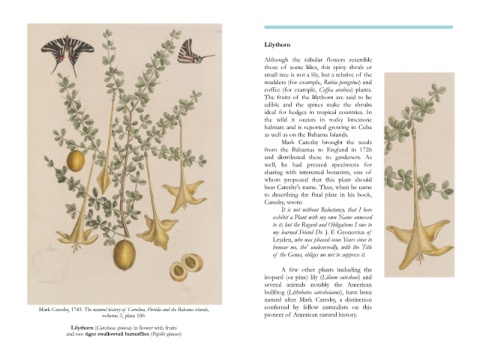
Lilythorn

                                                                                                                  Although  the  tubular  flowers  resemble
                                                                                                                  those  of  some  lilies,  this  spiny  shrub  or
                                                                                                                  small tree is not a lily, but a relative of the
                                                                                                                  madders (for example, Rubia peregrina) and
                                                                                                                  coffee (for example, Coffea arabica) plants.
                                                                                                                  The fruits of the lilythorn are said to be
                                                                                                                  edible  and  the  spines  make  the  shrubs
                                                                                                                  ideal  for  hedges  in  tropical  countries.  In
                                                                                                                  the  wild  it  occurs  in  rocky  limestone
                                                                                                                  habitats and is reported growing in Cuba
                                                                                                                  as well as on the Bahama Islands.
                                                                                                                         Mark  Catesby  brought  the  seeds
                                                                                                                  from  the  Bahamas  to  England  in  1726
                                                                                                                  and  distributed  these  to  gardeners.  As
                                                                                                                  well,  he  had  pressed  specimens  for
                                                                                                                  sharing  with  interested  botanists,  one  of
                                                                                                                  whom  proposed  that  this  plant  should
                                                                                                                  bear Catesby's name. Thus, when he came
                                                                                                                  to  describing  the  final  plate  in  his  book,
                                                                                                                  Catesby, wrote:
                                                                                                                         It is not without Reluctancy, that I here
                                                                                                                     exhibit a Plant with my own Name annexed
                                                                                                                     to it; but the Regard and Obligations I owe to
                                                                                                                     my learned Friend Dr. J. F. Gronovius of
                                                                                                                     Leyden, who was pleased some Years since to
                                                                                                                     honour me, tho' undeservedly, with the Title
                                                                                                                     of  the Genus, obliges me not to suppress it.


                                                                                                                         A  few  other  plants  including  the
                                                                                                                  leopard (or pine) lily (Lilium catesbaei) and
                                                                                                                  several  animals  notably  the  American
                                                                                                                  bullfrog (Lithobates catesbeianus), have been
                                                                                                                  named  after  Mark  Catesby,  a  distinction
                                                                                                                  conferred  by  fellow  naturalists  on  this
                  Mark Catesby, 1743. The natural history of  Carolina, Florida and the Bahama islands,
                                             volume 2, plate 100.                                                 pioneer of American natural history.


                               Lilythorn (Catesbaea spinosa) in flower with fruits
                             and two tiger swallowtail butterflies (Papilio glaucus)

