


Page 43 - Advanced Course
P. 43
KNX ADVANCED COURSE

                     Flow temperature (°C)
                           100°C
                            90°C
                            80°C                                              Characteristic curve
                            70°C                                              with ambient
                            60°C                                              temperature
                            50°C                                              Characteristic curve
                                                                              without ambient
                            40°C                                              temperature
                            30°C
                            20°C
                            10°C

                                  +20°C +10°C   0°C  -10°C  -20°C
                                                    External temperature (°C)

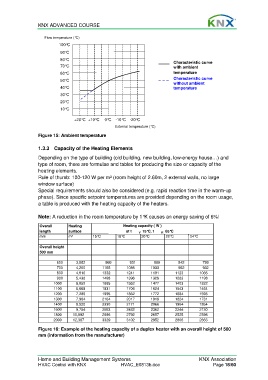
                  Figure 15: Ambient temperature

                  1.3.3  Capacity of the Heating Elements

                  Depending on the type of building (old building, new building, low-energy house…) and
                  type of room, there are formulae and tables for producing the size or capacity of the
                  heating elements.
                  Rule of thumb: 100-120 W per m² (room height of 2.60m, 2 external walls, no large
                  window surface)
                  Special requirements should also be considered (e.g. rapid reaction time in the warm-up
                  phase). Since specific setpoint temperatures are provided depending on the room usage,
                  a table is produced with the heating capacity of the heaters.

                  Note: A reduction in the room temperature by 1°K causes an energy saving of 6%!

                   Overall     Heating                  Heating capacity ( W )
                   length      surface                   at t  V  75°C, t  R   65°C
                   mm          m²         15°C       18°C       20°C       22°C      24°C

                   Overall height
                   500 mm

                          600      3,582        999        931       886        842        799
                          700      4,200      1165       1086       1033        982        932
                          800      4,816      1332       1241       1181       1123       1065
                          900      5,436      1498       1396       1329       1263       1198
                         1000      6,052      1665       1552       1477       1403       1332
                         1100      6,668      1831       1706       1624       1543       1464
                         1200      7,286      1998       1862       1772       1684       1598
                         1300      7,904      2164       2017       1919       1824       1731
                         1400      8,520      2330       2171       2066       1964       1864
                         1600      9,754      2663       2482       2362       2244       2130
                         1800    10,992       2996       2792       2657       2525       2396
                         2000    12,387       3329       3102       2952       2806       2663
                  Figure 16: Example of the heating capacity of a duplex heater with an overall height of 500
                  mm (information from the manufacturer)


                  Home and Building Management Systems                                    KNX Association
                  HVAC Control with KNX                HVAC_E0813b.doc                          Page 18/60

