


Page 42 - Advanced Course
P. 42
KNX ADVANCED COURSE

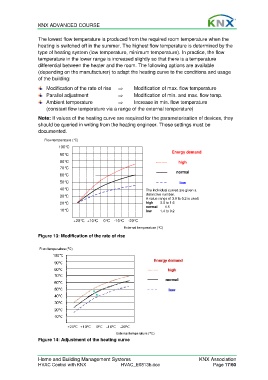
                  The lowest flow temperature is produced from the required room temperature when the
                  heating is switched off in the summer. The highest flow temperature is determined by the
                  type of heating system (low temperature, minimum temperature). In practice, the flow
                  temperature in the lower range is increased slightly so that there is a temperature
                  differential between the heater and the room. The following options are available
                  (depending on the manufacturer) to adapt the heating curve to the conditions and usage
                  of the building:

                      Modification of the rate of rise   ⇒   Modification of max. flow temperature
                      Parallel adjustment            ⇒       Modification of min. and max. flow temp.
                      Ambient temperature            ⇒       Increase in min. flow temperature
                      (constant flow temperature via a range of the external temperature)

                  Note: If values of the heating curve are required for the parameterisation of devices, they
                  should be queried in writing from the heating engineer. These settings must be
                  documented.

                     Flow temperature (°C)
                           100°C
                                                                             Energy demand
                            90°C
                            80°C                                                high
                            70°C
                                                                               normal
                            60°C
                            50°C                                                 low
                            40°C                                  The individual curves are given a
                            30°C                                  distinctive number.
                                                                  A value range of 3.0 to 0.2 is used.
                            20°C                                  high  3.0 to 1.6
                                                                  normal      1.5
                            10°C                                  low   1.4 to 0.2
                                  +20°C +10°C  0°C  -10°C  -20°C
                                                        External temperature (°C)
                  Figure 13: Modification of the rate of rise


                  Figure 14: Adjustment of the heating curve


                  Home and Building Management Systems                                    KNX Association
                  HVAC Control with KNX                HVAC_E0813b.doc                          Page 17/60

